

When your mortgage deal is ending, your lender will probably send you a letter or an email with a new rate. It looks quick and easy, and for many homeowners it is. But is it the best deal for you? That is where mortgage product transfer advice comes in. This guide explains what advice is, when you need it, how it differs from simply accepting your lender’s offer, what it may cost and how to choose someone you can trust.
What is mortgage product transfer advice?
Product transfer advice is a personal recommendation from a qualified mortgage adviser about which new deal to take when your current one ends. The adviser looks at your situation, explains the options and recommends a deal that suits you. Crucially, the recommendation is regulated: it has to be suitable for your needs, not just the cheapest headline rate.
This is different from information. A lender can tell you what its deals are and what they cost. That helps, but it is not the same as someone looking at your plans, your budget and the alternatives and telling you what they would do in your position. If you are new to the basics, start with our complete guide to a mortgage product transfer.
Advised or execution-only?
There are two broad ways to arrange a product transfer in the UK.
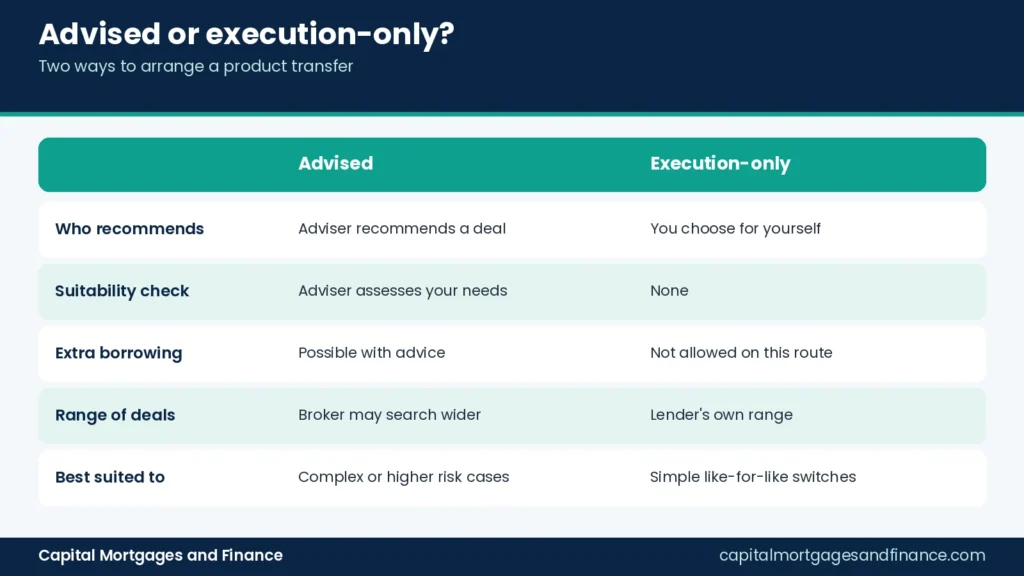
Advised. An adviser, either at your lender or at an independent firm, assesses your circumstances and recommends a deal. They must make sure the recommendation is suitable. If you are borrowing more, changing the structure of your mortgage or have a complicated situation, advice is normally required.
Execution-only. You choose the deal yourself and the lender processes it without making a recommendation. Under the FCA’s mortgage rules (see MCOB 4.8A in the FCA Handbook), a rate switch can generally be done on this basis only in limited circumstances, broadly where you are not borrowing more and the lender has made clear which of its products you are eligible for. Where those conditions are not met, the advice rules apply.
The key point is that execution-only means you are making the decision. If you choose well, there is no problem. If you pick a deal that turns out to be poor value, the lender is not responsible for steering you away from it.
When mortgage product transfer advice is worth having
You do not always need advice. A straightforward like-for-like switch on a small balance can be perfectly sensible to arrange yourself. But advice is often worth it when:
- You want to borrow more. Home improvements, debt consolidation or helping family buy a home all change the rules. Extra borrowing is generally not allowed on the execution-only route.
- Your circumstances have changed. A new job, self-employment, a drop in income, a separation or a new partner can all affect which lenders and products suit you.
- Your credit profile has changed. If you have missed payments or taken on new credit, an adviser can judge whether a product transfer or a remortgage is more realistic.
- You have a large balance or high LTV. Small rate differences add up over a big loan. Our LTV calculator shows where you stand.
- You are close to retirement or on interest-only. Term, repayment strategy and lender criteria matter more here.
- You are unsure about fixed versus tracker. The right choice depends on your budget and appetite for risk, as explained in our guide to how a mortgage rate switch works.

What a good product transfer review covers
A proper review is more than a rate comparison. Expect an adviser to discuss:
- Your goals. Do you want certainty, flexibility, the lowest possible rate or the option to overpay?
- Your plans. Are you likely to move, extend, remortgage, sell or change the mortgage in the next two to five years? The answer affects deal length and early repayment charges.
- The total cost. Rate, fees, early repayment charges and the effect on monthly payments over the full deal, not just the first month.
- The alternatives. Whether a remortgage with another lender could be cheaper after fees, and whether your own lender could offer a better product if you ask.
- The paperwork. A written recommendation (often called a suitability report) and the key facts about the product you choose.
Our product transfer calculator is a helpful starting point because it shows how a new rate changes your monthly payment, so you can have a more focused conversation with an adviser.
How much does product transfer advice cost?
Costs vary, and you should always ask before you proceed. Advisers are paid in different ways:
- A fee paid by you, which may be a fixed amount or a percentage of the loan.
- A procuration fee (commission) from the lender, which you do not pay directly but which the adviser is entitled to disclose.
- A combination of both.
Regulated firms must give you clear information about how they are paid before you commit. If the figure is not clear, ask for it in writing. A good adviser will not be offended. As a guide, if the saving from advice is larger than the fee you pay, it has paid for itself. For example, on a £200,000 balance with 20 years left, a difference of just 0.25 percentage points in rate is worth roughly £28 a month, which adds up to about £680 over a two-year deal. The exact saving depends on the rate, so use the calculator rather than relying on a rule of thumb.
How to choose a product transfer adviser
Choose carefully, because this person is helping with what is probably your biggest monthly bill.
- Check they are authorised. Search for the firm on the Financial Services Register and confirm it has permission to advise on mortgages.
- Ask how many lenders they can access. Some firms cover the whole market, others only a panel. Neither is wrong, but you should know which one you are dealing with.
- Ask whether they include your own lender’s product transfer. Some deals are available directly from the lender only. A good adviser will tell you when that is the best route.
- Look for clear communication. You should understand the recommendation, not just accept it.
- Know your rights. If something goes wrong, you can complain to the firm and, if unresolved, take the complaint to the Financial Ombudsman Service for free.
Video: UK MORTGAGE EXPERT – 5 Key Things You Need to Know (Alex Kerr, Mortgage Chain Ltd, UK).
Questions to ask before you accept a recommendation
- Why is this deal better for me than the alternatives?
- What will I pay in total over the deal period, including fees?
- What is the early repayment charge, and when does it reduce or end?
- Can I overpay, and by how much, without a penalty? See our overpayment calculator guide.
- Can I reserve this rate now and switch if a cheaper one appears?
- What will happen to my payment when this deal ends?

Free, impartial guidance in the UK
If you want to understand your choices before talking to anyone who sells mortgages, there are free sources. MoneyHelper, the government-backed service, explains remortgaging to cut costs and what happens if you change provider. Citizens Advice offers a debt and money section if you are worried about affording your payments. Free guidance does not give you a personal recommendation, but it can help you ask better questions. If your deal is ending soon and you are worried about affordability, tell your lender early: the Mortgage Charter gives eligible borrowers extra options, as set out on GOV.UK.
Worked example: advised versus self-arranged
Imagine a couple with a £220,000 balance and 22 years left on their mortgage. Their fixed rate ends in four months and their lender emails them a product transfer at 5.99% with a £999 fee. They are happy with the process but decide to speak to an adviser first.
The adviser reviews their plans and learns that they expect to move home in about three years. That matters, because a five-year deal could trigger an early repayment charge if they sell in year three. The adviser compares the lender’s offer with a two-year fixed rate from another lender and a three-year fixed rate from their own lender. After fees, the three-year product transfer is slightly cheaper than the two-year remortgage and avoids legal and valuation work. The adviser also points out that the couple could reserve the rate now and keep checking until the end date.
In this example the benefit of advice was not a dramatically lower rate. It was avoiding a deal length that did not fit their plans, and understanding the total cost. That is typical: good advice often saves money by preventing a mistake as much as by finding a headline-grabbing rate. The figures here are illustrative only and are not a quote.
Common myths about product transfer advice
“My lender will always give me its best rate.” Lenders show you the products they offer, but they do not have to recommend the cheapest deal in the market. Some also offer different product ranges to existing customers and to new customers, so it is worth comparing.
“Advice is only for people with complicated finances.” Complicated cases certainly benefit, but even straightforward cases can gain from a second opinion on deal length, fees and flexibility. A short conversation can be enough.
“I will be pushed into a remortgage.” A responsible adviser compares both routes and recommends the one that suits you. If a product transfer is best, that is what you should hear. Remember to ask how the adviser is paid so you can judge for yourself.
“It will take weeks.” A product transfer review can often be completed in a few days. Starting early, ideally about six months before your deal ends, simply gives you more choice and time to compare.
“I can only get advice from my own lender.” You can speak to your lender’s advisers, but you can also use an independent broker, who may be able to arrange the product transfer for you or compare it with the wider market.
What to have ready for your adviser
Gather a few details before your first conversation. It makes the process faster and the advice more accurate:
- your latest mortgage statement, showing the balance, rate, term and end date;
- an estimate of your property’s current value, which you can check against recent local sales;
- a note of any changes in income, employment or household since you took out the mortgage;
- your plans for the next five years, such as moving, extending or overpaying; and
- the offer or letter from your lender, if you have already received one.
Frequently asked questions
Do I need advice for a mortgage product transfer?
Not always. A simple like-for-like switch can be done without advice. However, if you are borrowing more, changing your mortgage structure or your circumstances have changed, advice is usually needed and often valuable.
What is the difference between advice and execution-only?
With advice, an adviser recommends a deal that must be suitable for you. With execution-only, you choose the deal yourself and the lender does not make a recommendation. FCA rules limit when execution-only rate switches can be used.
How much does a mortgage adviser charge for a product transfer?
It varies. Some firms charge a fee, some are paid commission by the lender and some do both. Ask for the details in writing before you proceed so you know exactly what you will pay.
Can a broker access my lender's product transfer deals?
Often yes, but not always. Some product transfer deals are only available directly from the lender. A good broker will tell you which route offers the best result for your circumstances.
How do I check that an adviser is authorised?
Search for the firm on the Financial Conduct Authority’s Financial Services Register and check that it has permission for mortgage advice.
What if I am unhappy with the advice I receive?
Complain to the firm first. If you are not satisfied with the response, you can take the complaint to the Financial Ombudsman Service, which is free for consumers.
Is free guidance enough?
Free guidance from services such as MoneyHelper is useful for understanding your options, but it does not provide a personal recommendation. Many people use guidance first and then take advice if they need a recommendation.
Final thoughts
Mortgage product transfer advice is not compulsory for every switch, but it is often worth having when the stakes are higher, your situation is not straightforward or you simply want confidence that you are not leaving money on the table. At Capital Mortgages and Finance we review your lender’s offer, compare it with the market and explain the options in plain English. If your deal is ending in the next six months, contact us for a free conversation. You can also read about what a mortgage renewal adviser does.
This article is general information, not personal financial advice. Your home may be repossessed if you do not keep up repayments on your mortgage. Rules referred to are from the FCA Handbook and GOV.UK as at October 2026.
Need a website that brings in enquiries, or a CRM that follows them up automatically? Abbabeel Web builds fast, search-friendly WordPress websites and sets up GoHighLevel CRM systems, including sales pipelines, automated follow-ups, booking calendars and clear reporting for service businesses. Whether you run a mortgage practice or any other company, you can see our work at abbabeelweb.com or hire the team through our Fiverr profile. Get in touch today and let us build the website and CRM workflow that helps your business grow.