

Getting a letter about your mortgage deal ending can feel like a deadline you did not plan for. The good news is that it is also an opportunity. The few months before your deal finishes are when you have the most choice, the most leverage and the most time to save money. This guide explains what happens when a mortgage deal ends, how much it can cost to do nothing, and a practical timeline to follow so you stay in control.
What happens when your mortgage deal ends?
Most UK mortgages start with a deal period, often two, three or five years, where the interest rate is fixed or tied to a benchmark. When that period finishes, you do not repay the loan. Instead, you usually move automatically to your lender’s standard variable rate (SVR). The SVR is set by the lender, can change at any time and is often much higher than the new deals on offer.
Your balance, term and property stay exactly the same. Only the interest rate, and therefore your monthly payment, changes. Many lenders also remove the early repayment charge at this point, so you are free to leave without paying a penalty. That freedom is the reason this is the best time to compare your options.
What doing nothing could cost you
The SVR is the price of inaction. According to Uswitch on 26 October 2026, the average SVR was 7.24% across all lenders and 6.49% across the six biggest. By comparison, the average two-year fixed rate was 5.78% at 75% loan to value (LTV). The Bank of England’s Bank Rate is currently 3.75%, so the SVR sits a long way above it.
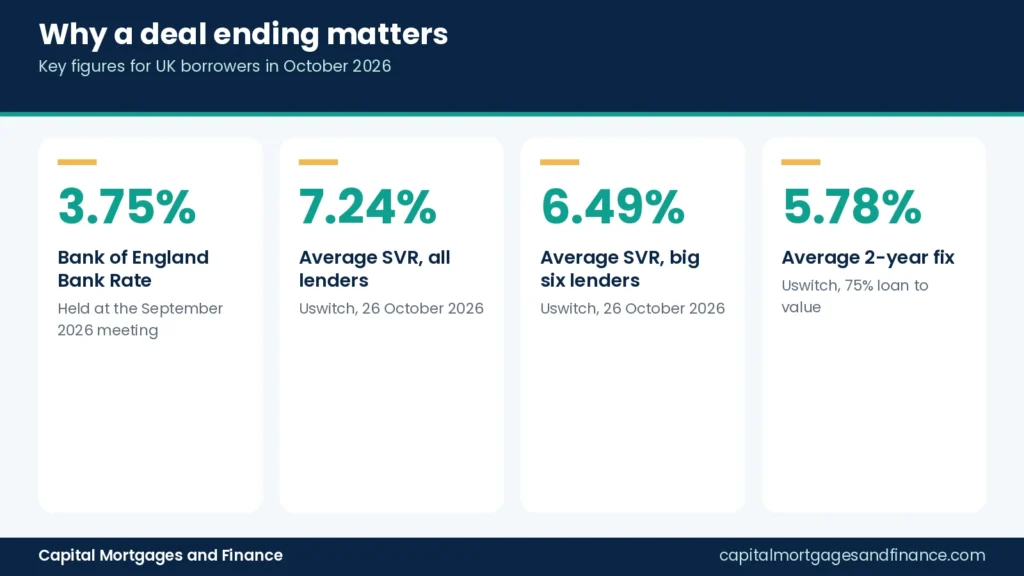
Let us put that into pounds. On a £200,000 balance with 20 years left, a repayment mortgage at 7.24% costs about £1,580 a month. At 5.78% it costs about £1,408. That is roughly £172 a month, or £2,064 a year, that you could save simply by moving to an average fixed deal. Even compared with the big-six average SVR of 6.49% (about £1,490 a month), moving to 5.78% would save about £82 a month. These are illustrative calculations to show the scale of the difference, not a quote for your own mortgage.
You can test your own numbers with our mortgage payment calculator or see how the interest and capital split changes in our guide to the mortgage repayment calculator.
A simple timeline for your mortgage deal ending
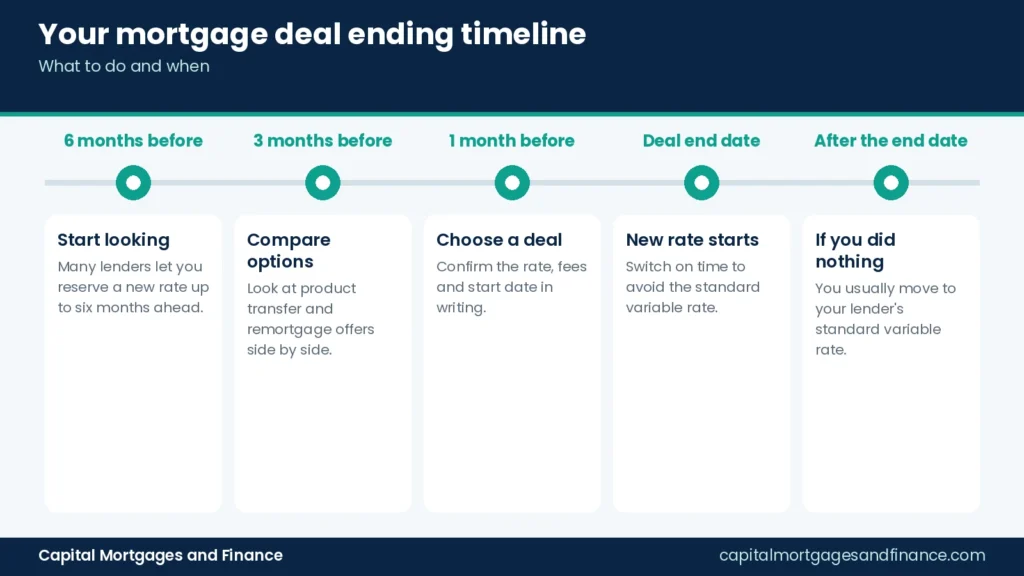
Around six months before: Check your end date and start looking. Many lenders let you reserve a new rate this far ahead, and some let you switch to a cheaper product in the window if rates fall. Ask yours how it works.
Around three months before: Compare the offers. See what your own lender can do (a product transfer) and what other lenders offer (a remortgage). Remember to include fees, not just the rate.
Around one month before: Choose your deal, apply if needed and confirm the start date in writing. If you are remortgaging, allow for the four to eight weeks it typically takes, according to Uswitch.
On the end date: Your new rate should begin automatically. Check your next statement to confirm the rate and payment.
If you miss it: You will usually move to the SVR. You can still switch at any time, but you will pay the higher rate until you do. Do not wait for a perfect moment: act as soon as you notice.

Your options when a mortgage deal is ending
1. Take a product transfer with your current lender
This is the quickest route. You stay with the same lender, choose a new deal and there is usually no legal work or valuation. It is often the simplest option if you want speed and low effort. Read our full guide to a mortgage product transfer for the details.
2. Remortgage to a new lender
A remortgage lets you compare the whole market and can be cheaper, especially if you have built up equity. It involves more paperwork, a full affordability check and sometimes a valuation, so start earlier. Our comparison of product transfer versus remortgage explains how to weigh the two.
3. Move to a different type of deal
You do not have to choose the same type of deal again. You can switch between fixed and tracker rates, change the deal length or choose a product that allows larger overpayments. For a plain-English comparison, see how a mortgage rate switch works.
4. Repay or sell
If you are selling soon, a short-term deal or the SVR may make sense for the period, depending on how long the sale takes. Ask about portability and early repayment charges before you commit to a long fix.
5. Do nothing
This is the default and almost always the most expensive option, unless you are about to repay the loan in full.
Work out your budget first
Before you compare deals, decide what monthly payment you can comfortably afford, including a buffer. Rates have moved a lot in recent years, and payments on a new deal may be different from the old one. If your old deal was fixed a few years ago at a lower rate, expect your new payment to be higher.
Use a calculator to model several rates and terms. Our product transfer calculator compares your current and new rates. If you are tempted to overpay, our overpayment calculator guide shows how extra payments can shorten your term, provided your deal allows them without a charge.
Video: Remortgage with High Interest Rates – WHAT TO DO? | Mortgage Rates UK | Mortgage Advice (Crescent Mortgages, UK).
What to have ready
Gather these before you speak to your lender or an adviser:
- your most recent mortgage statement, showing balance, rate, term and end date;
- an estimate of your property’s current value, which affects your LTV (use our LTV calculator);
- recent payslips or accounts if you are self-employed, in case a remortgage is needed;
- a list of your monthly outgoings and any debts; and
- your plans for the next five years, including any move, extension or change of job.
If you are worried about affordability
If you think you will struggle with the new payment, speak to your lender early. The Mortgage Charter, set out on GOV.UK, lets eligible borrowers explore options such as temporarily switching to interest-only or extending the term, with no impact on their credit file. Lenders have also agreed to give borrowers a way to switch to a new deal with the same lender without a new affordability assessment, provided they are not borrowing more.
For independent help, MoneyHelper has a clear page for anyone worried about rising mortgage payments, and Citizens Advice offers free support through its debt and money advice. Contacting them early gives you more options.

Mistakes to avoid
- Assuming your lender will remind you in time. Most do, but letters can be missed. Set your own reminder.
- Waiting for rates to fall. Nobody can predict rates. Reserving a rate and keeping an eye on the market is safer than waiting on the SVR.
- Choosing on rate alone. A lower rate with a high fee can cost more. Compare the total cost across the deal.
- Ignoring your plans. If you might move within two years, a five-year deal with a large early repayment charge could be expensive. Our guide to early repayment charges explains how they work.
- Not asking for help. A short call with an adviser can prevent a costly mistake. Read about mortgage product transfer advice if you are unsure.
How to read the letter from your lender
Around three to six months before your deal ends, most lenders write to you. The letter is easy to skim, but it contains several details that affect your next step:
- The end date. Confirm it matches your records. A deal that runs to the end of a month is different from one that ends mid-month.
- The reversion rate. This is the rate you will move to if you do nothing. Note it so you can compare it with new deals.
- The reservation window. Some lenders say how early you can choose a new rate. Others only mention it online, so check your account.
- Any early repayment charge. The letter should state whether one applies up to the end date, and whether it falls away afterwards.
- How to switch. It might be online, by phone or through an adviser. Note what your lender needs from you.
If you cannot find the letter, look at your online account or ring the lender. You are entitled to know your end date and your reversion rate at any time.
What to do in common situations
You took out a low fixed rate several years ago
If your last deal was fixed when rates were lower, your new payment is likely to be higher. This is where budgeting first matters. Test several terms, and consider whether extending the term slightly, or choosing a longer fix for more certainty, helps keep payments manageable. Extending the term lowers the monthly payment but increases the total interest, so use it carefully.
You have paid down a lot of the balance
A lower LTV can unlock better rates. Check your LTV against a realistic current valuation. If you have crossed a threshold, such as 75% or 60% LTV, a remortgage may open up cheaper deals than your lender’s product transfer range. It is worth comparing both.
You want to borrow more
Extra borrowing changes the rules. It usually means a full assessment and may mean taking a separate deal for the extra amount. Speak to an adviser before you apply so you can choose the best structure.
You are self-employed or your income has changed
A product transfer can be easier because the lender already has your mortgage. If your income has fallen, a simple switch with your current lender may be more realistic than a remortgage that needs fresh proof of income. Ask about the lender’s criteria and consider advice.
You are planning to sell or move
Avoid deals with heavy early repayment charges if you plan to sell within the deal period. Look for a portable mortgage, which you can take with you to a new property, or a shorter deal. Our guide to early repayment charges can help you decide.
An example: acting early versus waiting
Consider two neighbours with identical £200,000 balances and 20 years left, whose fixed rates both end on 1 March. The first neighbour starts looking in September, compares offers in December and switches to a 5.78% two-year fixed rate that starts on 1 March. The second neighbour misses the letter and is moved to a 7.24% SVR. If they notice after three months and then switch, they will have paid roughly £172 a month more for those months, or about £516 in extra payments, before any other effect. If they take six months to notice, the extra cost is around £1,032. These figures are illustrative, but they show why a diary reminder is worth setting.
Frequently asked questions
What happens when my mortgage deal ends?
Unless you arrange a new deal, you normally move onto your lender’s standard variable rate. Your balance and term stay the same, but your interest rate and monthly payment may rise.
How long before my deal ends should I act?
Around six months is a good time to start. Many lenders let you reserve a new rate up to six months ahead, and a remortgage can take four to eight weeks, so earlier is safer.
Can I switch before my mortgage deal ends?
Yes, but you may face an early repayment charge if you leave before the end date. Some lenders waive it in the last few months, so ask yours. Switching to a product transfer can sometimes be arranged to start on your end date.
What is the standard variable rate?
The standard variable rate, or SVR, is the rate a lender moves you to after your deal ends. It is set by the lender and can change at any time. Uswitch reported an average SVR of 7.24% on 26 October 2026.
Will my payment go up when my deal ends?
It might. If you move to the SVR, your payment will probably rise. A new deal could be higher or lower than your old payment depending on the rate you secured previously and current market rates.
Can I get help if I cannot afford the new payment?
Yes. Speak to your lender as early as possible. The Mortgage Charter gives eligible borrowers options such as switching to interest-only for a time or extending the term, and free help is available from MoneyHelper and Citizens Advice.
Do I need a mortgage broker when my deal is ending?
You do not have to use one, but a broker can compare product transfer and remortgage options for you. This is especially useful if your circumstances have changed or you want to borrow more.
Final thoughts
A mortgage deal ending is a deadline, but it is also your best chance to cut your costs. Know your end date, start comparing about six months ahead and avoid the SVR. If you would like help comparing your lender’s offer with the wider market, talk to our team. We will explain your options in plain English, with no obligation.
This article is for general information only and is not personal financial advice. Your home may be repossessed if you do not keep up repayments on your mortgage. Figures are from Uswitch (26 October 2026), the Bank of England and GOV.UK, and calculations are illustrative.
Need a website that brings in enquiries, or a CRM that follows them up automatically? Abbabeel Web builds fast, search-friendly WordPress websites and sets up GoHighLevel CRM systems, including sales pipelines, automated follow-ups, booking calendars and clear reporting for service businesses. Whether you run a mortgage practice or any other company, you can see our work at abbabeelweb.com or hire the team through our Fiverr profile. Get in touch today and let us build the website and CRM workflow that helps your business grow.