

If your fixed rate is about to end, a mortgage product transfer is probably the simplest way to avoid your lender’s expensive standard variable rate. You stay with the same lender, pick a new deal, and your new rate starts when the old one finishes. There is no new lender to impress, usually no legal work and often no valuation. This guide explains how a product transfer works in the UK, what it costs, when it is the right move and when a remortgage might beat it.
We are a UK product transfer specialist, so we see the same questions every week: how early can I switch, will I be asked for proof of income, and is my lender’s offer actually any good? You will find clear answers to all three below, with figures checked against sources dated October 2026.
What is a mortgage product transfer?
A product transfer, sometimes called a rate switch, is a change of mortgage deal with the lender you already have. Your loan, your property and your lender stay the same. What changes is the product: the interest rate, the length of the deal and sometimes the fees and early repayment terms.
It matters because most UK mortgages are not designed to last their whole term on one rate. A typical deal is fixed for two or five years. When that period ends, you are normally moved onto the lender’s standard variable rate (SVR), which is usually higher than the deals on offer. Switching to a new product before that happens is the main reason homeowners use a product transfer. For a plain-English definition from another angle, see our guide on what a product transfer mortgage is.
How a product transfer works, step by step
Every lender runs the process a little differently, but the shape is almost always the same.
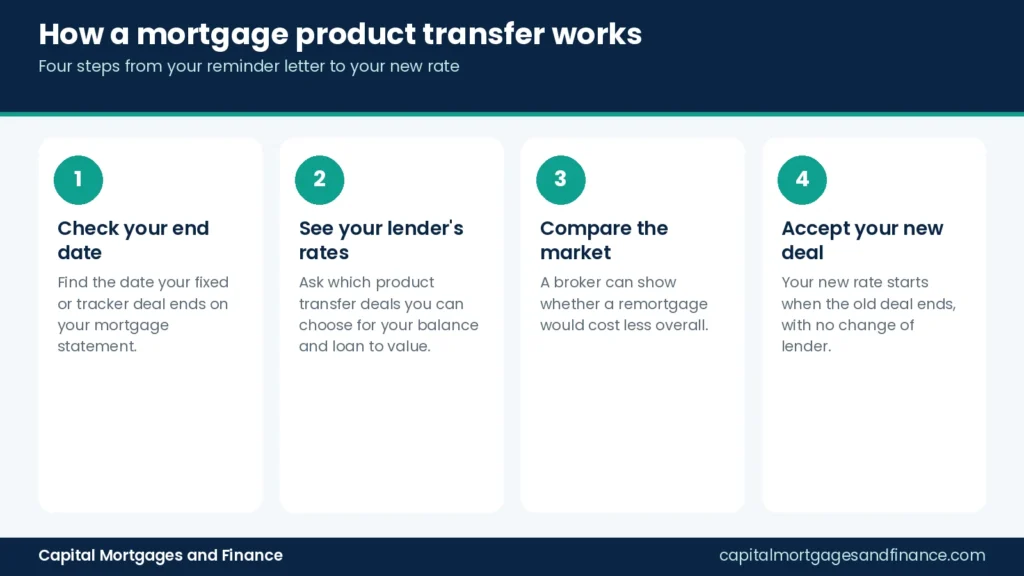
- Find your end date. Check your latest annual statement or your online account for the date your current deal finishes. Put it in your diary, along with a reminder six to seven months earlier.
- Ask for your options. Your lender will show the product transfer deals open to you, based on your balance and your loan to value (LTV). Our LTV calculator shows where you currently sit.
- Compare the real cost. Look beyond the headline rate. Add up the product fee, the early repayment charge and the monthly payment over the whole deal. The product transfer calculator helps with this.
- Choose and confirm. Accept the deal and check the start date in writing. In most cases the new rate starts the day your old deal ends.
If you would like the longer version with common pitfalls, read our step-by-step product transfer process.
What a product transfer costs
Product transfers have a reputation for being cheap, and compared with a remortgage they often are. The reason is simple: when you stay with the same lender, many of the usual remortgage costs fall away.
- Legal fees: usually not needed for a like-for-like transfer, because the lender already holds the legal charge on your home.
- Valuation fees: often waived, although the lender may use an automated valuation to confirm your LTV.
- Product (arrangement) fees: these still apply on many deals. They vary widely, and some lenders let you add the fee to the loan. Adding it means you pay interest on it.
- Early repayment charges (ERCs): usually not payable if you switch when your current deal ends. If you move early, an ERC may apply, although some lenders waive it in the last few months. Our guide to early repayment charges on a product transfer covers this in detail.
- Broker fees: if you use a mortgage broker, they may charge a fee, take commission from the lender, or both. Ask for this in writing before you proceed.
Here is why the fee matters. Take a £200,000 balance with 20 years left. At the average standard variable rate of 7.24% reported by Uswitch on 26 October 2026, repayments would be about £1,580 a month. At the average two-year fixed rate of 5.78% they would be about £1,408 a month. That is a difference of roughly £172 a month, or £2,064 a year, before any fee. If a product fee is £999, you recover it in under six months. These are illustrative repayment calculations, not a quote, and your own rate will depend on your LTV and lender.

When to arrange a product transfer
Timing is the single biggest lever you control. Most lenders let you reserve a new product transfer rate up to about six months before your current deal ends. Reserving early means you lock in today’s rate. If rates fall before your end date, many lenders will let you switch to a cheaper rate in the same window, but this varies, so ask your lender.
The Mortgage Charter, agreed between the Government, the FCA and major lenders, also supports borrowers here. Under the charter, lenders that signed up allow customers who are up to date with payments to lock in a new deal up to six months ahead and to switch to a better deal with the same lender without a new affordability test, as long as they are not borrowing more. You can read the details on GOV.UK’s Mortgage Charter page.
The Bank of England’s Bank Rate is 3.75% at the time of writing, after the Monetary Policy Committee held it in September 2026, with the next decision due on 5 November 2026. You can follow the current rate and the decision dates on the Bank of England’s Bank Rate page. Nobody can time rates perfectly, which is why reserving a rate and keeping the option to switch is a sensible, low-regret approach.
Video: Remortgage or Product Transfer | Mortgage Advisor Discussion (WIS | UK Mortgages & Financial Advice, UK).
Product transfer or remortgage?
A remortgage means moving your mortgage to a different lender. It opens up the whole market, which can mean a lower rate, particularly if your LTV has fallen because you have paid down the loan or your property has risen in value. It also brings more work: a new application, a full affordability check, a valuation and legal work. Uswitch notes that remortgages typically take four to eight weeks, whereas a product transfer can often be done in days.
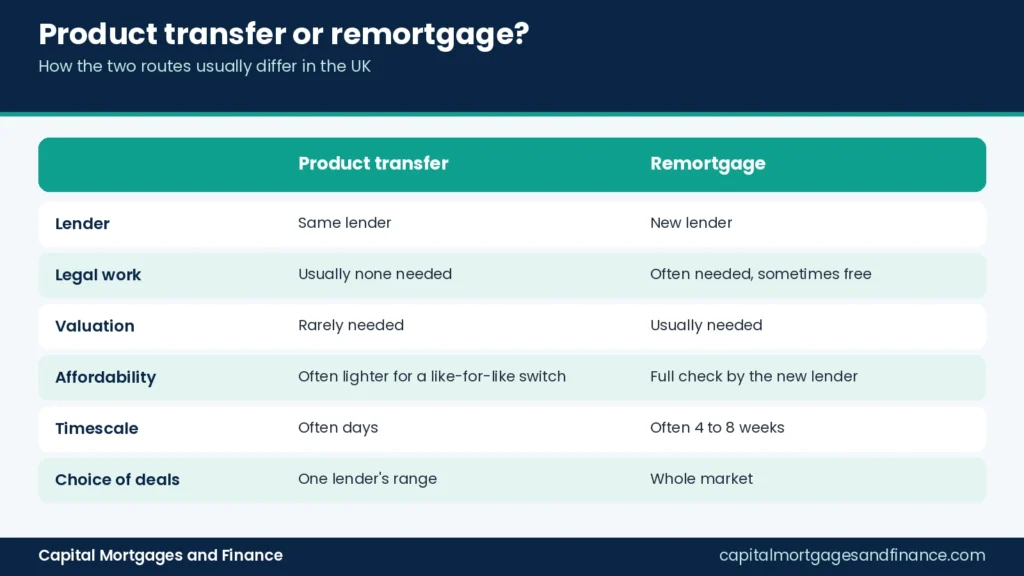
As a rule of thumb, a product transfer wins when you want speed, minimal paperwork, a simple like-for-like switch, or when your circumstances have changed in a way that might make a new lender hesitate, such as a change in job, self-employment or a lower credit score. A remortgage may win when you have a lot of equity, a large balance, or the difference between your lender’s rate and the best market rate is large enough to cover any extra costs. The honest answer is to compare both before deciding. Our dedicated article on product transfer versus remortgage walks through that comparison with examples.
Mortgage rates in October 2026
According to Uswitch on 26 October 2026, the average two-year fixed rate was 5.78% and the average five-year fixed rate was 5.81% (both at 75% LTV across all lenders). The average SVR was 7.24% across all lenders and 6.49% for the biggest six lenders. These are averages. Your own offer could be higher or lower depending on your LTV, your lender and the fees attached to the deal.
The practical lesson is that sitting on an SVR is almost always the most expensive option. Even if you are unsure which deal is best, moving onto any competitive fixed or tracker product is usually better than doing nothing. Use our mortgage payment calculator to see what a new rate would do to your monthly cost, and our mortgage repayment calculator guide to understand how your payment splits between interest and capital.
Who can do a product transfer?
Most homeowners who are up to date with payments can. Lenders generally expect that you:
- have no arrears, or only minor recent ones, on the mortgage;
- are not asking to borrow more, or are doing so under separate lending rules;
- are not changing the structure of the loan, for example moving from interest-only to repayment or adding or removing a borrower, in which case further checks may apply; and
- are within the lender’s maximum LTV for the product you want.
If you want to borrow more, add someone to the mortgage, remove a partner or change the term, the lender may need to do a full affordability assessment, and the process looks more like a remortgage. If your circumstances are complicated, speak to an adviser before applying. Our article on mortgage product transfer advice explains when advice is worth having.
Common mistakes to avoid
- Waiting until the deal has ended. You will usually be moved onto the SVR automatically, so every month of delay costs money.
- Taking the first offer. Lenders are not required to show you the best deal in the market. Compare it with other lenders, even if you plan to stay.
- Ignoring fees. A slightly lower rate with a high product fee can cost more over a two-year deal. Always compare total cost.
- Forgetting about ERCs. Choose a deal length you can realistically keep. If you might move house or sell within two years, a shorter deal or a portable product may suit you better.
- Not checking the paperwork. Make sure the rate, the start date and the fees match what you were told.
Product features worth checking
Two deals with the same rate can behave very differently. Before you accept a product transfer, check these features:
- Overpayment allowance. Many deals allow overpayments of up to 10% of the balance a year without a charge. If you plan to pay extra, this matters. Our overpayment calculator guide shows the effect of overpaying.
- Portability. Can you take the mortgage with you if you move? Not every deal is portable, and your new property would still need to meet the lender’s criteria.
- Payment holidays or flexibility. Some products allow a short break or the ability to borrow back what you have overpaid. Terms vary, so read the details.
- Fee options. Some deals have a lower rate with a high fee and others have a higher rate with no fee. Choose based on your balance and how long you expect to keep the deal.
- Cashback or incentives. Rare on product transfers, but worth asking about.
An example product transfer
Sam has a £180,000 balance with 18 years left. Her two-year fixed rate ends in three months, and her lender offers a new two-year fix at 5.80% with a £999 fee, or 5.95% with no fee. On a repayment basis, 5.80% costs about £1,345 a month and 5.95% costs about £1,360. That is a difference of around £15 a month, or roughly £360 over two years. The fee option costs £999 and saves about £360, so the no-fee deal is cheaper overall in this case, unless she adds the fee to the loan and spreads it out. These are illustrative figures only, but they show why the cheapest-looking rate is not always the cheapest deal.
Frequently asked questions
What is a mortgage product transfer?
A mortgage product transfer is a switch to a new mortgage deal with your existing lender. Your loan and property stay the same. Only the product, such as the interest rate, deal length and fees, changes.
How much does a mortgage product transfer cost?
Costs vary by lender. Legal and valuation fees are usually not needed, but many deals carry a product fee, which can be paid upfront or added to the loan. If you switch before your current deal ends, an early repayment charge could apply. Always compare the total cost of each deal.
How early can I arrange a product transfer?
Many lenders let you reserve a new rate up to six months before your current deal ends. Lenders that signed the Mortgage Charter allow customers who are up to date with payments to lock in a rate up to six months ahead.
Does a product transfer affect my credit score?
A like-for-like product transfer often needs only a light check, or none, because you are not applying for new credit. Policies differ between lenders, so ask yours whether a credit search will be carried out.
Is a product transfer better than a remortgage?
Not always. A product transfer is usually faster and simpler, while a remortgage gives you access to the whole market and may offer a lower rate. Comparing both is the safest way to decide.
Can I do a product transfer if I want to borrow more?
Usually not on the simple route. Borrowing more normally means a fuller assessment, and different rules apply. An adviser can explain your options.
What happens if I do nothing when my fixed rate ends?
In most cases you move onto your lender’s standard variable rate, which is often higher than available fixed deals. Uswitch reported an average SVR of 7.24% on 26 October 2026.
Final thoughts
A mortgage product transfer is quick, usually cheap and avoids the SVR. It is not always the cheapest option on the market, but it is often the best balance of cost, speed and certainty. Start looking about six months before your deal ends, compare your lender’s offer with the wider market, and read the fees as carefully as the rate. If you would like a second pair of eyes, get in touch with our team for a free initial conversation.
This article is for general information only and is not personal financial advice. Rates and rules can change. Your home may be repossessed if you do not keep up repayments on your mortgage. Sources include Uswitch (26 October 2026), GOV.UK and the Bank of England.
Need a website that brings in enquiries, or a CRM that follows them up automatically? Abbabeel Web builds fast, search-friendly WordPress websites and sets up GoHighLevel CRM systems, including sales pipelines, automated follow-ups, booking calendars and clear reporting for service businesses. Whether you run a mortgage practice or any other company, you can see our work at abbabeelweb.com or hire the team through our Fiverr profile. Get in touch today and let us build the website and CRM workflow that helps your business grow.