

When your fixed rate ends, you can stay with your lender and take a new deal, or move to a new lender. These two routes are called a product transfer and a remortgage, and choosing between them can change how much you pay over the next few years. This product transfer vs remortgage guide compares them side by side: speed, cost, eligibility, paperwork and risk, with worked examples using current UK figures. By the end you should know which route is likely to suit you and how to check.
What each route means
A product transfer means switching to a new mortgage deal with your existing lender. Your loan stays in place and only the product changes. Our mortgage product transfer guide explains it in full.
A remortgage means taking out a new mortgage with a different lender to repay your existing one. It involves a new application, a new valuation in most cases and legal work to move the charge on your property. MoneyHelper explains the basics in its guide to remortgaging to get the best deal.
Product transfer vs remortgage at a glance
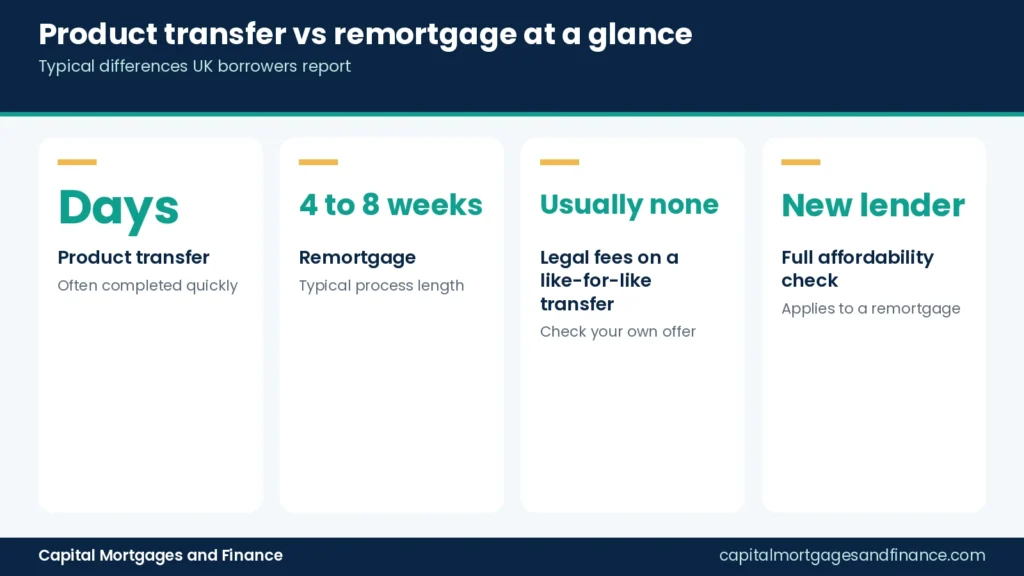
As a general guide, a product transfer is faster, simpler and usually cheaper to arrange, while a remortgage offers a wider choice and can deliver a lower rate. Neither is always better. The right answer depends on your balance, your loan to value (LTV), your circumstances and the gap in rates.
Speed and effort
Uswitch notes that a product transfer is often done in days, while a remortgage typically takes four to eight weeks. A remortgage usually involves:
- a full application and affordability assessment;
- proof of identity, income and outgoings;
- a valuation of your property, sometimes arranged by the lender at no cost;
- legal work to release the old charge and register the new one; and
- a completion date when the new lender pays off the old mortgage.
A product transfer skips most of these steps, because the lender already holds your mortgage. This is why it is popular when time is short. For a deal timeline, read our guide to a mortgage deal ending.
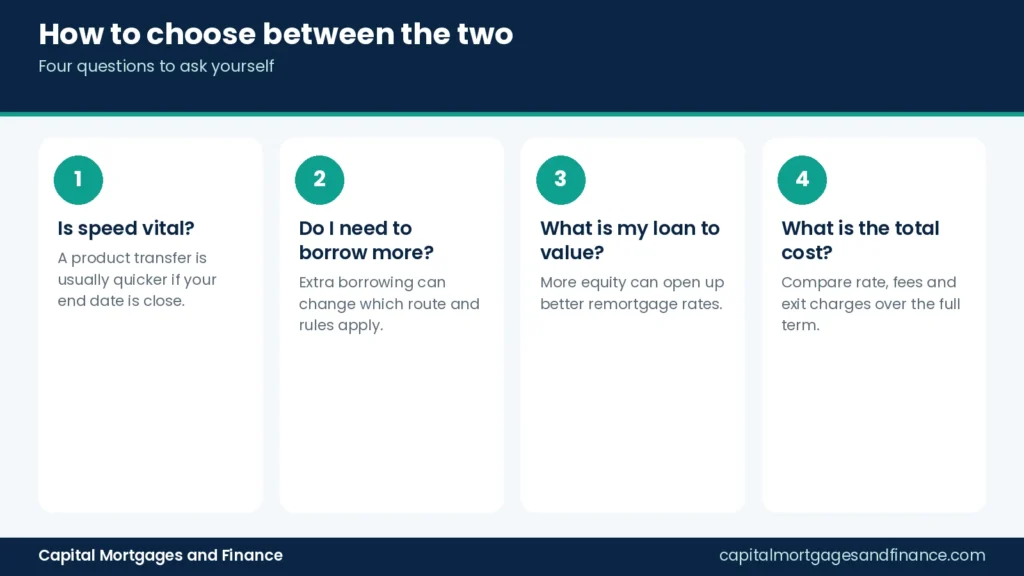
Cost: a worked comparison
Let us compare the cost of both routes using realistic numbers. On 26 October 2026, Uswitch reported an average two-year fixed rate of 5.78% at 75% LTV. Suppose your lender offers a two-year product transfer at 5.78% with a £999 fee, and a remortgage deal from another lender is priced at 5.45% with a £1,499 fee but free legal work and a free valuation. These are illustrative figures, not quotes.
| Scenario | Monthly saving on remortgage | Two-year saving | After extra £500 fee |
|---|---|---|---|
| £80,000 over 10 years | about £13 | about £315 | about £185 worse off |
| £200,000 over 20 years | about £37 | about £900 | about £400 better off |
| £350,000 over 25 years | about £70 | about £1,660 | about £1,160 better off |
The pattern is clear. On a small balance, a lower rate does not cover a higher fee, so the product transfer wins. On a large balance, the same rate difference is worth much more, and the remortgage can win comfortably. Do not forget that the remortgage also takes more time, and the figures above ignore any cashback or valuation costs, which can shift the result either way. A quick way to test your own numbers is our product transfer calculator alongside the mortgage payment calculator.

Eligibility and affordability
With a remortgage, the new lender must be satisfied that you can afford the mortgage. It will look at your income, outgoings, debts and credit history, and run stress tests to check you could cope if rates rose. If your circumstances have worsened since you took out your mortgage, you may find it harder to remortgage.
With a like-for-like product transfer, many lenders do not carry out a full affordability assessment. The Mortgage Charter, set out on GOV.UK, also says that lenders that signed up will let eligible borrowers switch to a new deal with the same lender without a new affordability test, provided they are not borrowing more. This makes a product transfer the safer route if you have had a drop in income, started self-employment or have a lower credit score than before.
Why your loan to value matters
Your loan to value is your mortgage balance divided by your property’s value. A lower LTV usually means access to cheaper rates, and many lenders price in bands such as 60%, 75%, 85% and 90%. If you have paid down your mortgage or your home has risen in value since your last deal, you could move into a lower band. Use our LTV calculator to find your current position.
Your own lender may re-price you to the new band when you do a product transfer, but not always as quickly or as favourably as a new lender competing for your business. If your LTV has improved, a remortgage is more likely to unlock the benefit, so it is worth comparing both.
Video: Remortgage UK Explained | When to Remortgage & How the Process Works (WIS | UK Mortgages & Financial Advice, UK).
When a product transfer is likely to win
- Your deal ends soon and you do not have time for a remortgage.
- Your balance is small, so fees outweigh any rate saving.
- Your income has fallen, or you are self-employed with less than the usual proof of income.
- You have a lower credit score than when you took out the mortgage.
- Your property is non-standard and may be harder to value for other lenders.
- You want the simplest process with minimal paperwork.
When a remortgage is likely to win
- You have a large balance, where even a small rate difference saves a lot.
- Your LTV has fallen into a lower band.
- Your lender’s product transfer rates are not competitive.
- You want to borrow more, or change the structure of your mortgage, and a new lender offers a better package.
- You can use incentives, such as free legal work, free valuations or cashback.
- You have time to complete the process before your deal ends.

How to decide: a five-step method
- Get your lender’s best product transfer offer. Note the rate, the fee, the early repayment charge and the overpayment allowance.
- Check your LTV. See whether you are in a lower band than last time.
- Get one or two remortgage quotes from a broker or comparison tool, including fees and incentives.
- Calculate the total cost of each over the deal period, including time and the risk of delays.
- Pick the best fit. If the remortgage saves a meaningful amount after all costs, it is worth the extra effort. If the saving is small, the simplicity of a product transfer is often the better choice.
If you are unsure, advice can help. Read about mortgage product transfer advice and what a mortgage renewal adviser does. You can also look at consumer guides, such as Which?’s overview of remortgaging.
Risks and pitfalls to watch for
- Delays on a remortgage. If the process takes longer than expected, you may slip onto the SVR.
- Valuation shortfall. If a valuer values your home lower than expected, your LTV may rise and the rate on offer may be worse.
- Early repayment charges. Leaving your current lender before your deal ends could trigger a charge. See our guide to early repayment charges on a product transfer.
- Hidden fees. Look for exit fees, booking fees and broker fees as well as the product fee.
- Assuming loyalty pays. Staying with your lender is convenient, but not always cheapest.
What a remortgage can cost
When people say a remortgage is more expensive, this is usually what they mean. Not every cost applies to every deal, and many lenders offer incentives to offset them:
- Product or arrangement fee: charged by the new lender, often between nothing and a four-figure sum, paid upfront or added to the loan.
- Valuation fee: frequently free on remortgages, but sometimes charged, especially on larger or unusual properties.
- Legal fees: many remortgage deals include free standard legal work, but if yours does not, expect to pay a solicitor or conveyancer.
- Exit or administration fee: some lenders charge a fee when you close your mortgage with them.
- Early repayment charge: only if you leave before your current deal ends.
- Broker fee: if you use a broker who charges one.
Check each of these before you decide. A remortgage that looks cheaper on the rate can lose its advantage once all these costs are added up. A broker or lender should give you a clear illustration of costs and monthly payments.
Three short case studies
Case 1: the quick switch
Hannah has a £95,000 balance and a deal ending in five weeks. A remortgage would be unlikely to complete in time, and the saving on a small balance would be modest. She takes her lender’s two-year product transfer, which starts on her end date. She avoids the SVR, spends very little time on it and plans to review her options when the new deal nears its end.
Case 2: the equity gain
Imran and Sara took out their mortgage three years ago at 90% LTV. Since then, they have paid down some of the loan and the value of their home has risen. When they check, they find their LTV is now about 72%, which puts them in a cheaper band. Their lender’s product transfer rate is competitive but not the best on the market. A remortgage through a broker shows a lower rate with free legal work and valuation, and they have four months to spare. They remortgage and save several hundred pounds a year compared with the product transfer.
Case 3: the changed circumstances
Grace has moved from full-time employment to being self-employed since she took out her mortgage, and she has less than two years of accounts. A remortgage lender might not accept her income yet. A product transfer with her existing lender does not require a fresh income assessment in the same way, so she takes it, keeps her payments manageable and plans to remortgage once she has built up a longer trading history.
These examples are illustrations, not predictions. They show that the right answer depends on timing, size, equity and circumstances, and that it is common to use a product transfer now and revisit the question at the next renewal.
Can you do both?
Yes, in a sense. Many homeowners reserve a product transfer rate several months ahead, which gives them a safety net, and then keep checking the market. If a remortgage offer beats the product transfer by enough to cover its costs and the timing works, they can switch. If not, they stay with the product transfer. Because many lenders let you cancel or change a reserved rate without a fee, this approach gives you protection and choice. Ask your lender about its terms before you reserve. You can read more about this in our guide to switching your mortgage deal with the same lender.
Frequently asked questions
What is the difference between a product transfer and a remortgage?
A product transfer moves you to a new deal with your current lender, while a remortgage moves your mortgage to a different lender. The first is usually quicker and simpler, the second gives access to the whole market.
Is a product transfer cheaper than a remortgage?
Often it is cheaper to arrange because legal and valuation fees are usually not needed. But a remortgage can have a lower rate, which can save more on larger balances. Compare the total cost.
Which is faster, a product transfer or a remortgage?
A product transfer is usually faster, often completed in days. Uswitch says a remortgage typically takes four to eight weeks.
Do I need an affordability check for a product transfer?
For a simple like-for-like switch, many lenders do not carry out a full affordability assessment. Under the Mortgage Charter, signed-up lenders let eligible borrowers switch without a new affordability test, provided they are not borrowing more.
Can I get a better rate by remortgaging?
You might, particularly if your loan to value has fallen or your lender’s rates are not competitive. A broker or comparison tool can show you whether the saving covers any extra fees.
Should I use a broker to compare both routes?
A broker can compare your lender’s product transfer with the wider market and explain which suits you best. It is especially helpful if your circumstances have changed or you want to borrow more.
Can I switch from a product transfer to a remortgage later?
Yes, but check for early repayment charges on the product transfer. Many people review their options again when the new deal approaches its end date.
Final thoughts
In the product transfer vs remortgage decision, the best route is the one that gives you the lowest total cost with a process you are comfortable with. A product transfer is usually quicker and simpler, while a remortgage can save more on larger balances or lower LTVs. Compare both before you decide, and start about six months before your deal ends. If you would like a clear side-by-side comparison for your own mortgage, contact our team. You may also like our guide to fixed rate mortgage ending options.
This article is for general information only and is not personal financial advice. Your home may be repossessed if you do not keep up repayments on your mortgage. Figures are illustrative and based on October 2026 sources; your own rates and fees will vary.
Need a website that brings in enquiries, or a CRM that follows them up automatically? Abbabeel Web builds fast, search-friendly WordPress websites and sets up GoHighLevel CRM systems, including sales pipelines, automated follow-ups, booking calendars and clear reporting for service businesses. Whether you run a mortgage practice or any other company, you can see our work at abbabeelweb.com or hire the team through our Fiverr profile. Get in touch today and let us build the website and CRM workflow that helps your business grow.