

An early repayment charge (ERC) is a fee your lender can apply if you pay off all or part of your mortgage more quickly than your deal allows. It matters for a product transfer because moving to a new product before your current one ends can trigger the charge, and because the new product will come with its own ERC. This guide explains how early repayment charges on a product transfer work in the UK, how they are calculated, when they apply, and the practical ways to avoid or reduce them.
What is an early repayment charge?
When a lender gives you a fixed or discounted rate, it plans around you paying that rate for the whole deal period. If you repay early, the lender loses expected income, and the ERC compensates for that. ERCs are common on fixed rate mortgages and some discounted and tracker deals, though some trackers have none. Your mortgage offer and key facts document must state whether an ERC applies and how it is worked out.
The charge normally stops when your deal period ends. After that, you can usually leave your lender or switch product without paying one. That is why timing a product transfer to start when your deal ends is so useful. For an overview of the process, see our mortgage product transfer guide.
How ERCs are calculated
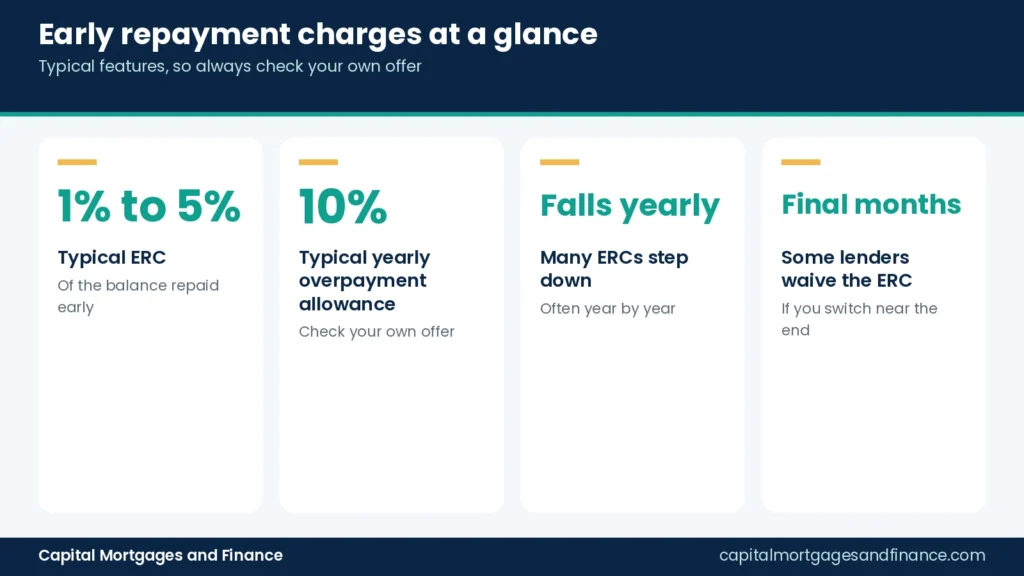
Most ERCs are a percentage of the amount you repay early. The percentage often falls each year of the deal. A typical structure for a five-year fix might be 5% in year one, 4% in year two, 3% in year three, 2% in year four and 1% in year five, though lenders set their own. Charges commonly fall in a range of about 1% to 5% of the balance repaid. Some lenders use a flat percentage throughout the deal, and a few calculate the charge in other ways, so always read your own terms.
Two points are worth remembering. First, the ERC usually applies only to the amount you repay above any overpayment allowance, not the whole balance. Second, some lenders reduce or remove the charge in the final months of the deal. Both are covered below.

When early repayment charges on a product transfer apply
A product transfer is a switch to a new product with the same lender, and the ERC question depends on timing.
- You switch when your current deal ends. No ERC applies. This is the normal and cheapest approach.
- You reserve a new rate in advance. Many lenders let you reserve up to about six months ahead, with the new product starting when your old one ends. Typically no ERC applies because you are not leaving early.
- You switch before the end date. The lender may charge the ERC on the amount being moved off the old product. Some lenders waive or reduce it for a product transfer in the last few months. Ask your lender, because policies differ.
- You switch during the new deal. The ERC of the new product then applies, which is why you should check it before accepting.
The Mortgage Charter, published on GOV.UK, also lets eligible borrowers lock in a deal up to six months ahead and switch to a better like-for-like deal with the same lender before their new rate begins. It is a useful way to avoid paying more than necessary, though not all lenders signed it, so confirm what yours offers.
A worked example
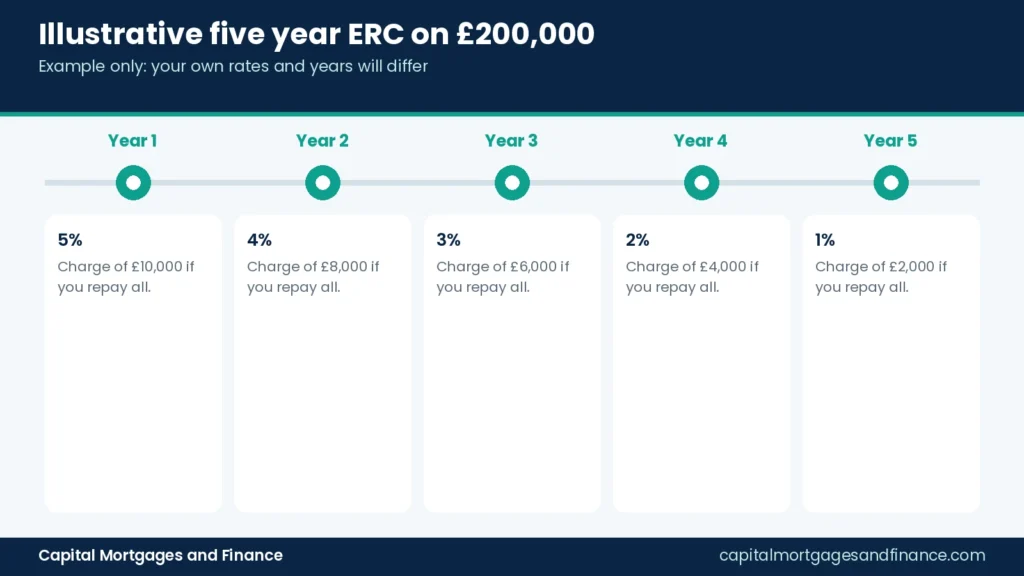
Suppose you have a £200,000 mortgage on a five-year fix with an ERC of 5%, 4%, 3%, 2% and 1% over the five years. If you repaid the whole balance in year three, the charge would be 3% of £200,000, which is £6,000. In year five it would be 1%, or £2,000. These are illustrative figures, not those of any specific lender.
Now imagine you are in the final year of a fix, with six months left, and your lender offers a cheaper product transfer that would save £120 a month. You have 6 months left, so the saving is £720. If the ERC is 1% on a £180,000 balance, that is £1,800, so switching early costs more than it saves. If the lender waives the ERC in the last three months, however, switching three months early would save £360 with no charge, which is worth having. The calculation is simple: monthly saving multiplied by the months remaining, minus the ERC and any new fee.
How to avoid or reduce an early repayment charge
- Switch on your end date. Check your statement for the exact date, and make sure the new product starts then.
- Reserve a new rate in advance. This gives you protection against rate rises without an ERC.
- Ask about waivers. Some lenders waive the ERC for a product transfer in the final months. It costs nothing to ask.
- Use your overpayment allowance. If you want to repay part of the mortgage, keep within the annual limit.
- Choose a deal length that fits your plans. If you may move or repay in two years, avoid a five-year fix with a large charge.
- Look at portable products. If a product is portable, you may be able to take it to a new property instead of repaying it, which can avoid the charge in a house move. Not all products are portable, and the new property must meet the lender’s criteria.
- Consider a tracker with no ERC. Some trackers have none, which gives freedom to leave but exposes you to rate changes.
Video: Mortgages 101: What is an early repayment charge (ERC)? (Habito, UK).
Overpayments and the annual allowance
Many mortgages let you overpay up to a set amount each year without a charge, commonly 10% of the outstanding balance. On a £200,000 balance, that is up to £20,000 a year. If you overpay more than the allowance in an ERC period, the charge normally applies to the excess only, though terms vary. For example, if you overpaid £25,000 with an allowance of £20,000 and a 3% charge, the excess would be £5,000 and the charge about £150. Always confirm how your lender applies it before making a large payment.
Overpaying can be a powerful way to save interest. Our overpayment calculator guide shows how extra payments shorten your term. Check the allowance before you start, and see whether the allowance resets on a calendar year or on your mortgage anniversary.
Is paying an early repayment charge ever worth it?
Sometimes. It can make sense if:
- the saving from the new deal exceeds the charge plus any new fees within a reasonable time;
- you need to sell or move and cannot port the mortgage;
- you are releasing money from an inheritance or windfall that would otherwise earn less than your mortgage rate; or
- your circumstances have changed, for example after a separation, and you need to restructure.
In other cases, waiting is usually cheaper. Before you decide, ask your lender for a redemption statement, which shows the exact charge on the day, and run the comparison. If you are unsure, consider mortgage product transfer advice.

Check the early repayment charge on your new deal
Before you accept a product transfer, look at the ERC on the new product as carefully as the rate. Ask:
- What is the ERC, and how does it reduce over the deal?
- How long does it apply?
- Does it apply to the whole balance or only the amount above the overpayment allowance?
- Can the ERC be waived if I port the mortgage or in the final months?
- Is there an exit fee on top?
For more on choosing a deal that fits your plans, see our mortgage product switch guide and our comparison of product transfer versus remortgage. MoneyHelper also explains how ERCs fit into mortgage fees and costs, and if you have a complaint about how a charge was applied, the Financial Ombudsman Service can look into it for free.
How to find your exact charge
The only reliable number is the one your lender gives you for the day you plan to repay. Percentages in a mortgage offer tell you the rule, but the amount depends on the balance and the date. Here is how to get a clear answer:
- Read your mortgage offer or key facts document. It states the ERC percentages, how long they apply and any overpayment allowance.
- Check your online account or app. Many lenders show your current ERC and the date it ends.
- Request a redemption statement. It shows the amount needed to repay the mortgage on a particular day, including any ERC and fees. Lenders may charge a small fee for this, so ask first.
- Ask about waivers. Ask whether the charge reduces or is waived if you move to a new product with the same lender.
Keep the figures in writing. If a lender quotes a charge that does not match your offer, ask for an explanation and, if you are not satisfied, make a complaint. The Financial Ombudsman Service can help if the firm cannot resolve it.
Case study: moving house during a fixed rate
Tom and Rhea are in year two of a five-year fix, with a £220,000 mortgage. A job move is likely within a year, and they worry about an early repayment charge of 4% in year two, which would be £8,800 if they repaid the mortgage in full. They ask their lender whether the mortgage is portable. It is, subject to the lender approving the new property and their affordability. They decide to port the mortgage, borrowing any extra needed on a separate product, and avoid the charge on the main loan. If they had not checked, they might have repaid the mortgage and paid thousands unnecessarily. This example is illustrative, but it shows why portability is worth checking before you commit to a long fix.
Common myths about early repayment charges
“There is never a charge on a product transfer.” A product transfer at the end of your deal usually carries no charge, but switching early can. The new product also has its own charge.
“The ERC is a fixed amount.” It is normally a percentage of the amount repaid, and it often reduces each year. The sum in pounds changes as your balance falls.
“Overpaying always triggers a charge.” Most deals let you overpay up to an annual allowance without a charge. The charge usually applies only above that limit.
“All deals have an ERC.” Some trackers and the standard variable rate have none. These can be useful if you value flexibility, though they come with their own trade-offs.
“I cannot avoid it if I need to move.” You may be able to port the mortgage, or time the move for when the deal ends. Ask your lender early.
Frequently asked questions
What is an early repayment charge on a mortgage?
An early repayment charge is a fee your lender may apply if you repay all or part of your mortgage early during a fixed or discounted deal. It is usually a percentage of the amount repaid and often falls each year.
Do I pay an early repayment charge on a product transfer?
Usually not if you switch when your current deal ends. If you switch before the end date, a charge may apply, although some lenders waive it in the final months. The new product will also have its own charge.
How much is a typical early repayment charge?
Commonly between about 1% and 5% of the amount repaid, often reducing each year of the deal. Your mortgage offer states the exact figures for your product.
Can I overpay without an early repayment charge?
Many deals allow overpayments up to a limit, commonly 10% of the balance a year. Overpaying beyond the allowance may trigger a charge on the excess. Check your own terms before you make a large payment.
How do I find out my early repayment charge?
Check your mortgage offer or key facts document, look in your online account or ask your lender for a redemption statement, which shows the exact amount.
Can I avoid an early repayment charge when I move house?
Possibly. If your mortgage is portable, you may be able to take it to your new property instead of repaying it, subject to the lender’s criteria. Otherwise, a charge may apply if you repay during the deal.
Is it worth paying an early repayment charge to get a better rate?
Only if the saving from the new deal, after any new fees, is larger than the charge within a reasonable time. Work out the monthly saving multiplied by the months remaining, then subtract the charge and fees.
Final thoughts
Early repayment charges are avoidable in most product transfers if you plan your timing. Know your end date, reserve your new rate early and check the ERC on your new deal as carefully as the rate. If you would like help comparing the cost of switching now with waiting, talk to our team. You may also find our guide to what to do when your mortgage deal is ending helpful.
This article is for general information only and is not personal financial advice. Your home may be repossessed if you do not keep up repayments on your mortgage. Charges vary by lender; figures are illustrative and the rules described are as at October 2026.
Need a website that brings in enquiries, or a CRM that follows them up automatically? Abbabeel Web builds fast, search-friendly WordPress websites and sets up GoHighLevel CRM systems, including sales pipelines, automated follow-ups, booking calendars and clear reporting for service businesses. Whether you run a mortgage practice or any other company, you can see our work at abbabeelweb.com or hire the team through our Fiverr profile. Get in touch today and let us build the website and CRM workflow that helps your business grow.