

A mortgage renewal adviser helps you choose and arrange a new mortgage deal when your current one is about to end. That might mean switching to a new product with your existing lender, or moving your mortgage to a different lender. This guide explains exactly what a renewal adviser does, how they are regulated and paid, when it makes sense to use one, and how to pick someone you can trust anywhere in the UK.
What is a mortgage renewal adviser?
In the UK, a mortgage adviser is a person authorised and regulated by the Financial Conduct Authority (FCA), or working for a firm that is, who gives advice on mortgages. A renewal adviser specialises in the stage when a deal ends: reviewing your current mortgage, looking at your plans, comparing options and arranging the new product.
Many people use the words adviser and broker interchangeably. In practice, a broker is a firm that arranges mortgages from a range of lenders, and an adviser is the individual who gives the advice. Some lenders also employ their own advisers, who can recommend only that lender’s products.
What a mortgage renewal adviser does
A good adviser does much more than pick a rate from a list.
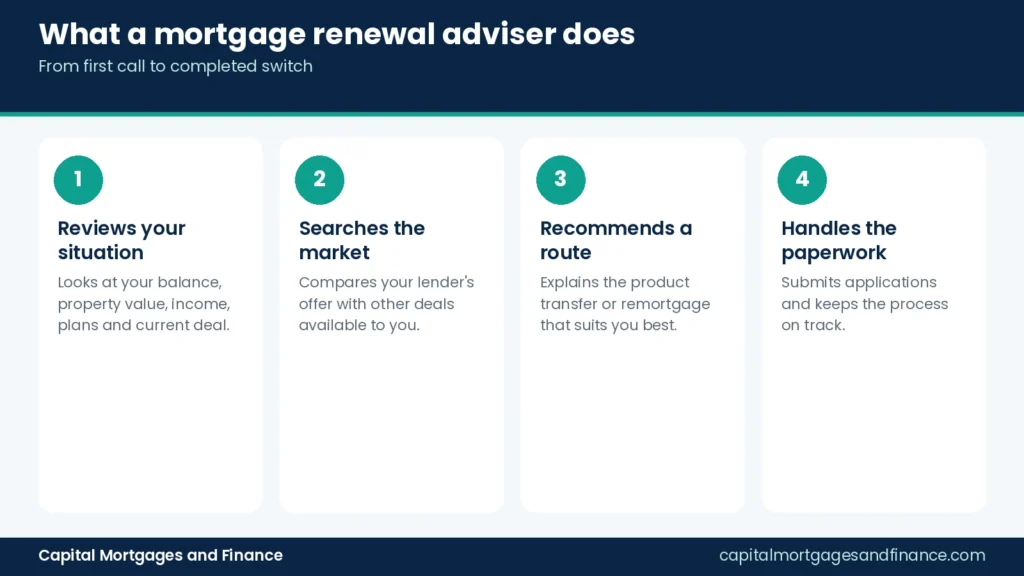
- Reviews your situation. They look at your balance, property value, income, outgoings, credit profile and plans. This identifies which lenders and products are realistic.
- Searches the market. They compare your lender’s product transfer deals with remortgage options. If they cover the whole market, they can look at a very wide range of lenders. If they are restricted, they will tell you which lenders they use.
- Recommends a route. They explain the choice between a product transfer and a remortgage, fixed or tracker, and the term, and tell you what they would recommend and why.
- Handles the paperwork. They submit the application, chase the lender, and keep you updated until your new rate begins.
- Keeps an eye on your rate. Some advisers will monitor rates after you reserve a deal and tell you if a better one appears before your start date.
If you want the background on the main route most renewals take, read our guide to a mortgage product transfer.
Types of mortgage adviser
Independent whole-of-market brokers
They can search the whole market, subject to the lenders they have access to, and often have exclusive deals not available to the public. They may charge a fee, take commission or both.
Restricted or tied advisers
They can only recommend products from a limited range of lenders. They must tell you this clearly. This can still be a good option if the range suits your needs.
Your lender’s own advisers
Your lender may offer an advice service for its existing customers. They know their own products well and can often arrange a product transfer quickly, but they cannot recommend another lender.
Specialist advisers
If you are self-employed, retired, have a non-standard property, a complex income or past credit issues, a specialist adviser may know which lenders are more flexible.

When should you use a mortgage renewal adviser?
You can renew a mortgage without an adviser, but an adviser is particularly worth considering when:
- you are not sure whether to take your lender’s product transfer or remortgage;
- you want to borrow more, add or remove someone from the mortgage, or change the term;
- your income, job, health or household has changed;
- you have missed payments or taken on new debt since your last deal;
- you have a larger balance, where small rate differences are worth more;
- you plan to move, let the property or overpay heavily; or
- you simply do not have the time or confidence to compare deals yourself.
If you are unsure whether you need advice, our article on mortgage product transfer advice explains the difference between advised and execution-only routes.
How are mortgage renewal advisers paid?
Advisers are paid in one of three main ways:
- A fee from you. This can be a flat fee or a percentage of the loan. You pay it whether or not you proceed, or on completion, depending on the firm.
- Commission from the lender. Called a procuration fee, this is paid by the lender when the mortgage completes. You do not pay it directly, but a good adviser will disclose it.
- Both. Many firms charge a fee and also receive commission.
Whichever model applies, you should be told before you commit. Ask for a clear statement of any fee, when it is payable and whether any part is refundable if the mortgage does not go ahead. Fees do not mean the advice is better, and no fee does not mean it is free, so judge the whole picture.
How to choose a mortgage renewal adviser
- Check the FCA register. Confirm the firm is authorised and has permission for mortgage advice using the Financial Services Register.
- Look at their qualifications and experience. Advisers typically hold a recognised qualification such as the Certificate in Mortgage Advice and Practice (CeMAP). Ask how much product transfer and remortgage work they do.
- Understand their panel. Ask which lenders they can access and whether they include your current lender’s product transfers.
- Ask about fees up front. They should be able to give you a figure and explain it in plain English.
- Check their communication. Do they explain things clearly, return calls and put recommendations in writing?
- Read reviews carefully. They are helpful, but look for detail rather than star ratings alone.
- Know where to complain. If something goes wrong and the firm cannot resolve it, you can take your complaint to the Financial Ombudsman Service, free of charge.
You do not need a local adviser. Most renewal advice is done by phone, video call and email, so you can choose an adviser anywhere in the UK, whether you live in London, Manchester, Glasgow, Cardiff or Belfast.
Video: What Does a UK Mortgage Broker 'Actually' Do? (Crescent Mortgages, UK).
What the renewal process looks like
While every firm is different, the typical process is:
- An initial conversation about your mortgage, plans and goals, usually 15 to 30 minutes.
- Fact-finding, where the adviser collects your mortgage statement, details about income and outgoings, and any plans that might affect your choice.
- Research and recommendation, including a comparison between a product transfer and any remortgage options.
- Agreement, where you confirm the recommended option and sign any forms.
- Application and completion. For a product transfer, this can be a matter of days. A remortgage commonly takes four to eight weeks, according to Uswitch, so allow extra time.
- Follow-up, where you check your next statement to confirm the new rate and payment.
Before the first call, use our product transfer calculator and LTV calculator to get a rough idea of your position. It helps you ask more focused questions.

An example of a renewal adviser in action
Aisha has a £210,000 balance, 19 years left, and a two-year fixed rate ending in four months. Her lender offers a new two-year fixed rate. She is planning to switch to part-time work in a year. The adviser compares her lender’s offer with two other lenders and reminds her that a remortgage would need fresh proof of income, which could be harder if her earnings fall. Given her plan, the adviser recommends a product transfer now, with a deal that allows her to overpay modestly while her income is higher. The recommendation avoids a more complicated remortgage and fits her plans. This example is illustrative, but it shows how advice looks beyond the headline rate.
Questions to ask a mortgage renewal adviser
- Are you independent, restricted or tied to a lender?
- How many lenders do you work with, and do you include my current lender’s product transfers?
- How are you paid, and how much will I pay in total?
- Can you explain why you recommend this option over the alternatives?
- What are the fees, the early repayment charge and the overpayment allowance?
- What happens if I want to change my mind, or rates fall before my start date?
- Will you stay in touch until my new rate begins?
Adviser or your own lender: how to decide
You do not have to pick one or the other. Many homeowners ask their lender for its product transfer options and, at the same time, speak to an adviser to compare them with the market. This gives you a benchmark. If the adviser can beat your lender’s deal after fees, or finds a better fit for your plans, you have a reason to switch. If the lender’s deal is best, a good adviser will say so.
Going direct tends to work well when your finances are simple, you do not plan to borrow more, you are comfortable reading product details and the amount at stake is modest. An adviser tends to add the most value when there is something to untangle, such as changes in income, a plan to move, a large balance or uncertainty about the right deal length. Neither approach is right for everyone, and the choice is yours.
Red flags to watch for
Most advisers are professional and helpful, but it is wise to know what a poor experience looks like. Be cautious if an adviser:
- Cannot show an FCA registration or avoids giving their firm’s name and reference number.
- Pressures you to decide quickly without explaining why. A deadline set by a lender’s rate expiry is fair, but artificial pressure is not.
- Avoids questions about fees or gives vague answers about how they are paid.
- Recommends a very long term or the highest possible borrowing without explaining the effect on total interest.
- Does not ask about your plans. A recommendation that ignores whether you are likely to move or overpay is unlikely to be suitable.
- Offers to inflate or alter your income details. This is never acceptable and could amount to fraud.
If you are unsure, take your time, ask for the recommendation in writing and speak to someone else for a second opinion.
Review your protection at renewal
A renewal is a good moment to check that your wider finances are protected, and a good adviser will raise this with you. Consider whether your buildings insurance matches the rebuild cost of your home, whether your life cover or critical illness cover still reflects your mortgage balance and your family’s needs, and whether income protection would help you keep up payments if you could not work. These are separate products, and you are not obliged to buy them to switch your mortgage deal, but checking them costs little and could matter a great deal.
What to do after your new rate starts
Once your new deal begins, there are a few simple steps that keep you in control:
- Check your statement. Confirm the rate, payment and end date match your offer.
- Set your next reminder. Add the end date of your new deal to your diary, plus a reminder six months before.
- Keep your documents. Save your offer, the key facts and the adviser’s recommendation in one place.
- Review your overpayment plan. If you can afford to overpay within your allowance, test the effect with our overpayment calculator guide.
- Tell your lender about big changes. If your income, job or household changes, it is better to speak to your lender early.
Frequently asked questions
What does a mortgage renewal adviser do?
A mortgage renewal adviser reviews your current mortgage, compares your lender’s product transfer options with remortgage deals, recommends a suitable route and arranges the application for you.
Is a mortgage renewal adviser the same as a mortgage broker?
Often, yes. A broker is a firm that arranges mortgages from several lenders, and an adviser is the person who gives the advice. Some lenders also have their own advisers, who can only recommend that lender’s products.
How much does a mortgage renewal adviser cost?
It varies. Some firms charge a fee, some are paid commission by the lender, and some do both. Ask for details in writing before you proceed so you know exactly what you will pay.
Can a mortgage adviser arrange a product transfer?
Yes. Many advisers can arrange a product transfer with your current lender, and compare it with remortgage options from other lenders, although some deals are available only directly from the lender.
How do I check my mortgage adviser is regulated?
Search for the firm and the individual on the FCA Financial Services Register. Confirm that the firm has permission to advise on mortgages.
Do I need a local mortgage adviser?
No. Most renewal advice is delivered by phone, video call and email, so you can use an adviser anywhere in the UK.
When should I speak to a renewal adviser?
Around six months before your deal ends is ideal. This gives enough time to reserve a product transfer rate or complete a remortgage, which can take four to eight weeks.
Final thoughts
A mortgage renewal adviser can save you time, help you avoid mistakes and may find a better deal than the one you would have chosen alone. Whether you need one depends on your circumstances, but a short conversation is usually worth it. If your deal ends in the next six months, contact Capital Mortgages and Finance for a clear comparison of your options. You can also read our guide on mortgage renewal help and our checklist for a mortgage deal ending.
This article is for general information only and is not personal financial advice. Your home may be repossessed if you do not keep up repayments on your mortgage. Check any adviser’s fees and permissions before you proceed.
Need a website that brings in enquiries, or a CRM that follows them up automatically? Abbabeel Web builds fast, search-friendly WordPress websites and sets up GoHighLevel CRM systems, including sales pipelines, automated follow-ups, booking calendars and clear reporting for service businesses. Whether you run a mortgage practice or any other company, you can see our work at abbabeelweb.com or hire the team through our Fiverr profile. Get in touch today and let us build the website and CRM workflow that helps your business grow.