

If your mortgage deal is coming to an end and you are not sure where to start, you are not alone. Millions of UK homeowners face a renewal every year, and the choices can feel confusing. This guide offers practical mortgage renewal help: what to do first, where to find free and regulated support, how to work out what you can afford, how to read the jargon, and how to avoid common traps, including scams. It is written in plain English, and every step is something you can do today.
Where to start with mortgage renewal
Begin with three facts: the date your deal ends, your outstanding balance and the rate you will move to if you do nothing. You will find them on your annual mortgage statement or in your online account. Once you have them, you can see how much time you have and what the cost of waiting could be.
According to Uswitch on 26 October 2026, the average standard variable rate (SVR) was 7.24% across all lenders, while the average two-year fixed rate was 5.78% at 75% loan to value. On a £200,000 balance with 20 years left, that gap is worth roughly £172 a month in repayments, so acting early matters. For a timeline, read our guide to a mortgage deal ending.
Where to get mortgage renewal help
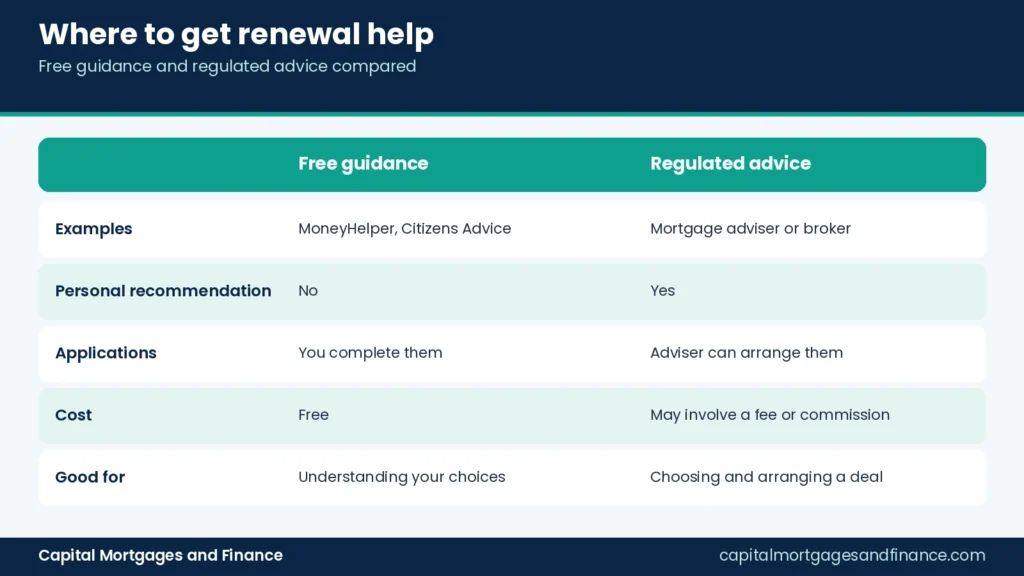
Your lender
Your lender will write to you before your deal ends and can explain the product transfer options available to you. This is the quickest route, but remember that your lender can only show its own products. Read more in our product transfer guide.
A regulated mortgage adviser or broker
An adviser gives you a personal recommendation based on your circumstances and can compare your lender’s offer with the wider market. Check that the firm is authorised on the FCA Financial Services Register and ask how they are paid. Our guide to a mortgage renewal adviser explains what to expect.
MoneyHelper
MoneyHelper is the government-backed service for free, impartial money guidance. Its page on remortgaging to get the best deal explains your options, and its article on changing your mortgage provider covers the basics. Guidance is not personal advice, but it helps you understand the choices.
Citizens Advice
Citizens Advice gives free, confidential help on money and housing problems, and has practical information in its debt and money section.
Consumer guides
Independent consumer sites can help you understand the market. For example, Which? has a guide to remortgaging, and MoneySavingExpert publishes mortgage guides and tools.

Work out what you can afford
Before you compare deals, decide what monthly payment you can comfortably manage. A simple approach is:
- List your monthly income after tax, including regular benefits and any reliable extra earnings.
- List essential outgoings such as utilities, council tax, food, transport, insurance, childcare and debt repayments.
- Add a buffer for the unexpected, ideally enough to cover a rise in your payment.
- See what is left for your mortgage and compare it with the payments on offer.
Then test the payment at several rates and terms. Our mortgage payment calculator and product transfer calculator make this quick. If you are considering overpaying later, see our overpayment calculator guide.
Jargon buster
- Product transfer / rate switch: moving to a new deal with your current lender.
- Remortgage: moving your mortgage to a new lender.
- SVR (standard variable rate): the lender’s default rate after your deal ends.
- LTV (loan to value): your mortgage balance as a percentage of your property’s value. Use our LTV calculator.
- ERC (early repayment charge): a fee for leaving or overpaying heavily during a deal.
- Tracker: a rate that follows the Bank of England Bank Rate plus a margin.
- Product fee: a fee for arranging the deal, paid upfront or added to the loan.
- Execution-only: arranging a deal yourself without a lender’s or adviser’s recommendation.
- Reversion rate: the rate you move to when your deal ends.
Video: What Is A Remortgage? Remortgaging After Fixed Term Ends (Tembo, UK).
Mortgage renewal help for special situations
Your income has changed
If your income has fallen, a product transfer with your current lender can be easier than a remortgage, because the lender already has your mortgage. Be honest with your lender about changes and consider advice.
You are self-employed
Remortgage lenders often ask for two or three years of accounts or tax calculations. A product transfer may need less documentation. If your earnings are variable, an adviser who knows lenders’ criteria can help.
You are approaching retirement
Check how your lender views your age and income at the end of the term. Options might include a shorter term, a repayment plan for an interest-only mortgage, or specialist lenders. Seek advice early.
You have an interest-only mortgage
Make sure you have a clear plan to repay the capital. MoneyHelper has guidance on ways of repaying an interest-only mortgage.
You want to borrow more
Borrowing extra normally needs a fuller assessment and advice. Speak to an adviser, and read about mortgage product transfer advice.

If you are struggling to pay
Tell your lender early. Under the Mortgage Charter, set out on GOV.UK, lenders that signed up agreed to offer options to borrowers who are worried about payments. These can include switching to interest-only for a period or extending the term to reduce monthly payments, without a negative effect on your credit file. Lenders also agreed not to force borrowers to leave their home without their consent within 12 months of a missed payment, except in exceptional circumstances. MoneyHelper has a page for anyone worried about rising mortgage payments, and Citizens Advice can help you plan your budget.
The earlier you ask for help, the more options you have. Acting before you miss a payment is almost always better than waiting.
Avoiding scams and poor advice
Whenever there is financial pressure, some firms try to take advantage. Protect yourself:
- Use only authorised firms. Check the FCA register before sharing personal details.
- Be wary of cold calls. An unsolicited call, text or email offering a special mortgage deal or asking for upfront fees should be treated with caution.
- Never pay large upfront fees to an unknown firm for a promise of a better deal.
- Do not sign anything you do not understand. Ask for time and for explanations in writing.
- Know where to complain. If a regulated firm treats you unfairly, you can escalate to the Financial Ombudsman Service.
Your renewal action plan
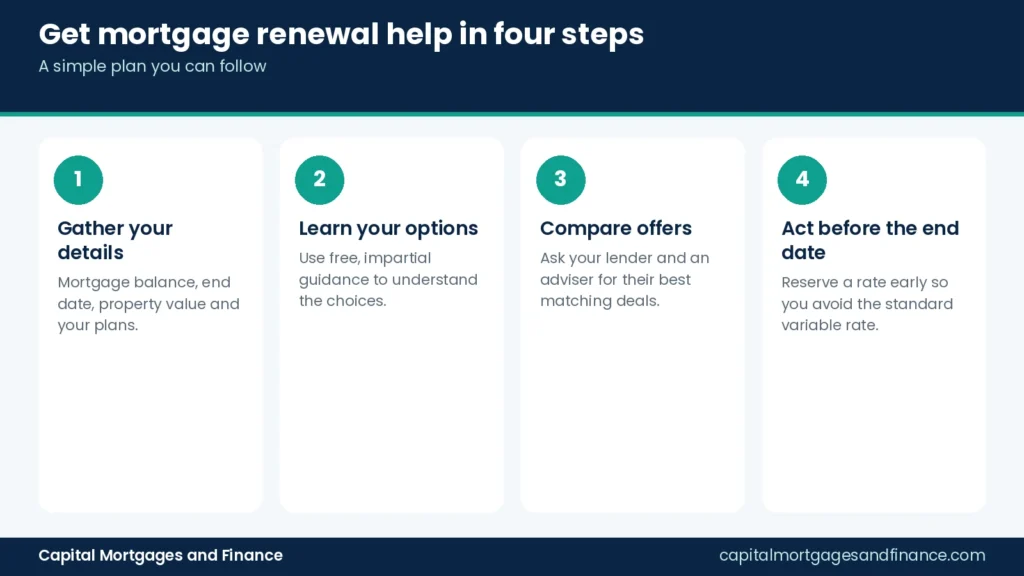
This week: find your end date, balance and reversion rate. This month: ask your lender for its options and speak to an adviser or use free guidance. Within three months: compare product transfer and remortgage costs, choose a deal and reserve the rate. Before the end date: confirm the start date in writing, and check your next statement afterwards.
Documents to gather before you call
Having the right information to hand makes every conversation quicker, whether you are speaking to your lender, an adviser or a free helpline. Collect the following:
- your latest mortgage statement, showing the balance, interest rate, remaining term and deal end date;
- your mortgage offer or key facts document, which sets out your early repayment charge and overpayment allowance;
- proof of identity and address, in case your lender or adviser asks for it;
- recent payslips, or accounts and tax calculations if you are self-employed, in case a remortgage is needed;
- a note of your monthly outgoings and any debts; and
- an up-to-date idea of your home’s value, based on recent sales of similar properties nearby.
Questions to ask when you ring your lender
It helps to have a short list ready. Try these:
- What is the exact date my deal ends, and what rate will I move to?
- What product transfer options can I choose from, and what are their fees?
- Is there an early repayment charge if I switch before the end date?
- How early can I reserve a new rate, and can I change it later?
- Can I speak to an adviser about my options, and is there a charge?
- What support is available if I am worried about affordability?
Write down the answers, together with the date and the name of the person you spoke to. If anything is confusing, ask them to repeat it or to send it in writing. You are entitled to understand what you are agreeing to.
A short example: getting help early
Ben and Laura have a £170,000 mortgage with 17 years left. Their five-year fix ends in five months and their payment is likely to rise. They are nervous about the change and unsure what to do, so they start with free guidance. They read MoneyHelper’s page on remortgaging, then use a payment calculator to test several rates. The couple discover that moving to an average fix of 5.78% would cost roughly £1,311 a month, compared with about £1,451 a month on an SVR of 7.24%, a difference of around £140 a month. Next, they call their lender to ask for product transfer options and speak to an adviser, who compares the offer with other lenders and confirms that the lender’s deal is competitive for their loan to value. Finally, they reserve the rate four months ahead and put a reminder in their diary. The process takes a few short phone calls, and it saves them money from day one. This example is illustrative, but it shows how a few simple steps can make renewal manageable.
If your deal ends very soon
Not everyone starts six months ahead, and that is fine. If your deadline is close, here is how to prioritise.
Less than two months to go
A product transfer is usually your best bet because it can be completed quickly, often in days. Ask your lender for its options straight away and choose a deal with a start date that matches your end date. A remortgage can take four to eight weeks, according to Uswitch, so it may not complete in time. If it does not, you can still move later, but you will pay the SVR in the meantime.
Less than one month to go
Contact your lender today and ask how quickly they can arrange a switch. Choose a sensible product rather than waiting for a perfect one. If you take a deal that is not ideal, you may still be able to switch to a better one later, though you should check the early repayment charge. Speed matters more than perfection here.
Your deal has already ended
You are probably on the SVR now. The best step is to switch as soon as possible. You are usually free to leave the SVR without paying an early repayment charge, so there is no penalty for acting now. Every month on a higher rate costs money, so do not wait until a more convenient time.
Whichever situation you are in, our guide to switching your mortgage deal with the same lender explains the quickest route, and our mortgage product switch guide helps you choose between product types.
Frequently asked questions
Where can I get free help with my mortgage renewal?
MoneyHelper and Citizens Advice offer free, impartial guidance. Your lender can also explain the options available to you, and the Financial Ombudsman Service handles complaints about regulated firms for free.
When should I start my mortgage renewal?
Around six months before your deal ends is ideal. Many lenders let you reserve a new rate that far ahead, and a remortgage can take four to eight weeks.
Do I have to use a mortgage broker to renew?
No. You can arrange a product transfer directly with your lender. A broker can compare the market and give a personal recommendation, which is helpful if your circumstances have changed or you want to borrow more.
What happens if I miss my renewal date?
You are usually moved to your lender’s standard variable rate, which is often higher than available fixed deals. You can still switch at any time, but you pay the higher rate until you do.
Can I renew my mortgage if my income has fallen?
Often yes. A product transfer with your current lender can be simpler than a remortgage, but each lender has its own criteria. Speak to your lender or an adviser as early as possible.
Is there help if I cannot afford my new payment?
Yes. Contact your lender early. The Mortgage Charter gives eligible borrowers options such as switching to interest-only for a period or extending their term, and free support is available from MoneyHelper and Citizens Advice.
How do I check that a mortgage adviser is genuine?
Search for the firm on the FCA Financial Services Register and check it has permission for mortgage advice. Be cautious about cold calls and upfront fees.
Final thoughts
Renewing a mortgage does not have to be stressful. Know your dates, ask for help early, compare more than one option and focus on the total cost and what suits your plans. If you would like friendly, clear support, contact Capital Mortgages and Finance and we will talk you through your choices. You can also read our guide to a fixed rate mortgage ending.
This article is for general information only and is not personal financial advice. Your home may be repossessed if you do not keep up repayments on your mortgage. Information is correct as at October 2026.
Need a website that brings in enquiries, or a CRM that follows them up automatically? Abbabeel Web builds fast, search-friendly WordPress websites and sets up GoHighLevel CRM systems, including sales pipelines, automated follow-ups, booking calendars and clear reporting for service businesses. Whether you run a mortgage practice or any other company, you can see our work at abbabeelweb.com or hire the team through our Fiverr profile. Get in touch today and let us build the website and CRM workflow that helps your business grow.