

You do not have to change lender to change your mortgage deal. If you want to switch your mortgage deal with the same lender, you can usually do it without a new application, without legal fees and often in a matter of days. This guide explains how an internal switch works, what to check before you accept, how to compare it with a remortgage, and how to make sure you get the best deal your lender can offer.
What does switching with the same lender mean?
Switching your mortgage deal with the same lender means moving to a new product, such as a new fixed or tracker rate, without leaving the lender that already holds your mortgage. The industry calls it a product transfer, a rate switch or an internal switch. Your loan stays in place, your property stays the same, and only the product terms change.
Most people do this when their current deal is ending, to avoid the lender’s standard variable rate (SVR). You can also switch part-way through a deal, but if you do, you may have to pay an early repayment charge. For the full picture, read our mortgage product transfer guide.
Benefits and drawbacks of switching with your lender
Benefits
- Speed. Uswitch reports that a product transfer can often be done in days, compared with four to eight weeks for a typical remortgage.
- Lower costs. Legal and valuation fees are normally not needed, because the lender already has the mortgage secured on your home.
- Less paperwork. Many like-for-like switches do not need a full affordability assessment or fresh proof of income.
- Certainty. You are dealing with a lender that already knows your payment history.
- Flexibility on timing. You can often reserve a new rate months ahead.
Drawbacks
- A narrower choice. You see only one lender’s products, which may not be the cheapest in the market.
- Limited borrowing changes. Borrowing more or changing the structure of the loan usually needs a fuller assessment.
- Possible fees. Product fees can still apply, and they vary widely between lenders.

How to switch your mortgage deal with the same lender, step by step
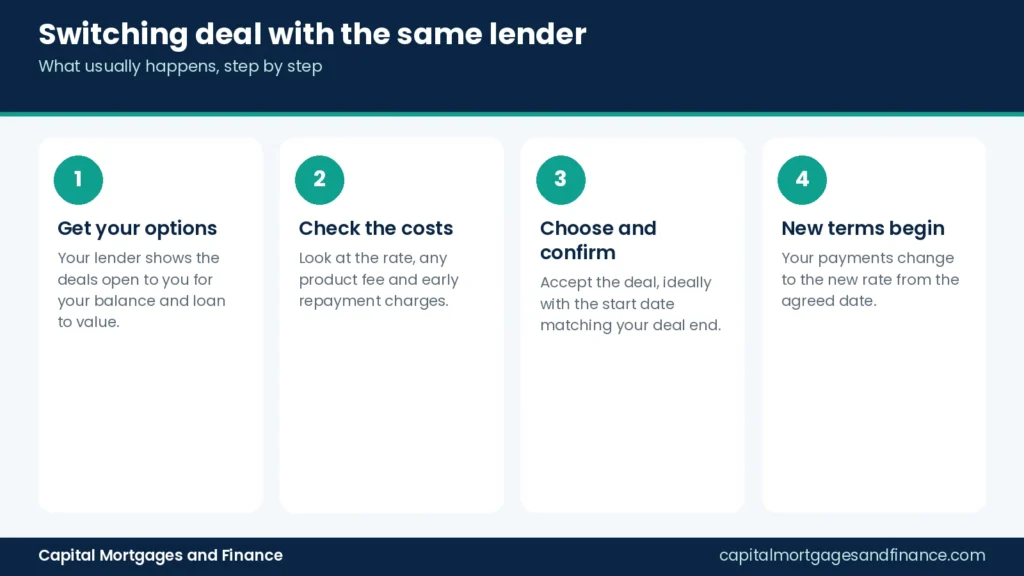
- Find your details. Locate your latest statement and note the balance, rate, term and end date.
- Ask your lender for your options. Many lenders show product transfer options in your online account or app. Otherwise, call or message them. Ask specifically about every product available to you, not just the headline deal.
- Check the costs. Note the rate, the product fee, the early repayment charge and the overpayment allowance for each option.
- Compare with the market. Before accepting, check what other lenders offer. Our product transfer calculator and a quick broker call can help.
- Choose and confirm. Accept the deal, ideally with a start date that matches your current end date. Get the offer in writing.
- Check your next statement. Make sure the new rate and payment are correct.
What to check before you accept
A quick comparison of rates is a start, but there are other details that can affect cost and flexibility. Check these before you say yes:
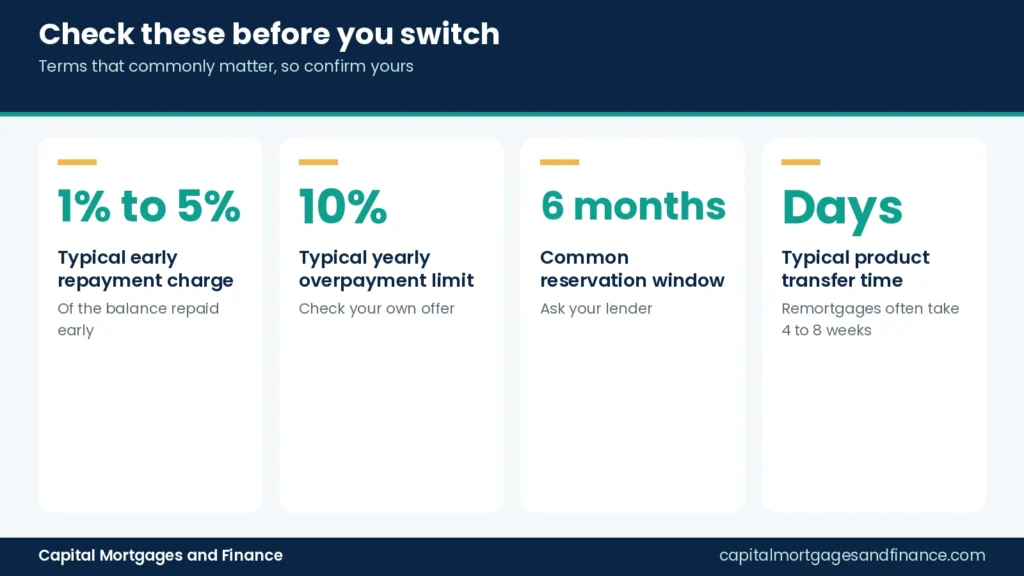
- The total cost, not just the rate. Work out the monthly payment plus fees over the deal period.
- The early repayment charge. It is typically between 1% and 5% of the balance repaid, often falling each year. Our guide to early repayment charges explains how this works.
- The overpayment allowance. Many deals allow around 10% of the balance a year. If you plan to overpay, see our overpayment calculator guide.
- The start date. Check it begins when your current deal ends, so you do not pay the SVR for a few weeks by mistake.
- Whether you can change your mind. Some lenders let you swap to a cheaper rate before the start date.
- Portability. If you may move, ask whether you can take the deal with you.
Are existing customer rates cheaper?
Not necessarily. Some lenders offer slightly different rates to existing customers than to new ones. Sometimes the existing customer range is cheaper, sometimes it is not. Brokers often see lenders’ broker-only rates that are not available when you contact the lender directly, and these are sometimes better. This is why it is worth asking an adviser to check whether the product transfer you are offered is competitive. The best rate is the one that suits your situation after fees, not simply the lowest percentage.
It is also worth asking if the lender has any other product transfer deals available to you. Some lenders show only a few products by default, and you may not see all the options unless you ask.
Video: Remortgage Tips UK | Mortgage Options (Move iQ, UK).
What if you want to borrow more?
If you want to borrow extra money, for example for home improvements, the process is different. Most lenders treat extra borrowing as a further advance, which needs an affordability assessment and sometimes a valuation. The extra borrowing may be on a separate product with its own rate and term. The FCA’s rules also treat extra borrowing differently from a simple rate switch, and in many cases advice is required. See the FCA’s rules on rate switches in MCOB 4.8A. If you want to borrow more, speak to an adviser about whether a further advance or a remortgage is more cost-effective. Our guide to mortgage product transfer advice explains when advice makes sense.
How to compare with other lenders
A remortgage can sometimes beat an internal switch, particularly if your loan to value (LTV) has fallen. Your LTV is the mortgage balance divided by the property’s value. Our LTV calculator shows where you stand. A lower LTV often unlocks lower rates. To compare fairly:
- Get the monthly payment and total fees for your lender’s best product transfer.
- Get the same figures for one or two remortgage deals from other lenders, including any free legal work or cashback.
- Add the likely valuation and legal costs if they are not included.
- Compare the total cost over the deal period, and consider time and effort too.
If the remortgage saves a significant amount after all costs, it may be worth the extra work. If the saving is small, the simplicity of an internal switch can be the better choice. We cover the comparison in detail in product transfer versus remortgage.

The Mortgage Charter and switching with your lender
The Mortgage Charter is a voluntary agreement between the Government, the FCA and lenders that gives borrowers extra options. For borrowers who are up to date with their payments, lenders that signed up will let you switch to a new deal with the same lender without a new affordability assessment, as long as you are not borrowing more, and will let you lock in a deal up to six months ahead. They will also allow you to switch to a better deal with the same lender before your new rate starts, if one becomes available. You can read the full details on GOV.UK. Not all lenders signed up, so ask yours what applies.
Example: switching with the same lender
Chloe has a £190,000 balance with 21 years left. Her two-year fix ends in five months. In her lender’s app, she sees a two-year fix at 5.70% with a £999 fee and a five-year fix at 5.85% with no fee. She wants to overpay by about £200 a month and expects to stay in her home for at least five years. She also checks the early repayment charge on each option. The five-year product allows overpayments of 10% a year and has a charge that falls from 5% to 1%. After checking the market, she finds that no remortgage beats it by enough to cover the extra work. She reserves the five-year product transfer, sets a reminder to check rates again in three months and confirms the start date in writing. This is an illustration only, but it shows the process: gather options, check the details, compare with the market and then decide.
What to say when you contact your lender
A short, prepared conversation tends to produce better results than a vague one. When you call or message your lender, consider asking the following:
- “When exactly does my current deal end, and what rate will I move to if I do nothing?”
- “Which product transfer deals am I eligible for, including fixed, tracker and different lengths?”
- “What are the fees, early repayment charges and overpayment allowances on each?”
- “Can I reserve a rate now, and can I switch to a cheaper one if rates fall before my start date?”
- “Do I need to do anything else, such as sign documents or provide proof of identity?”
Write down the answers, the name of the person you spoke to and the date. If your lender confirms terms by email or letter, keep those too. They are useful if anything changes later.
Changes to who is on the mortgage
A simple like-for-like switch assumes the same borrowers stay on the mortgage. If you want to add a partner, remove a former partner after a separation or change from a joint to a sole mortgage, the lender will usually treat this differently. It may need to assess affordability on the remaining borrower, check ownership documents and sometimes involve a solicitor. In these cases the process can be closer to a remortgage and may take longer. Let your lender or adviser know about this early, so you can plan your timeline and avoid slipping onto the SVR while paperwork is completed.
What if your lender says no?
Lenders can decline a product transfer if, for example, you are in arrears, the property no longer meets their criteria or you ask for a change they cannot accept. If that happens, do not panic. Ask for the reason in plain terms, and ask whether there are any other products or routes available. You may still have options:
- a different product with the same lender, perhaps with a higher rate or a shorter deal;
- a remortgage with a different lender, possibly through a specialist broker; or
- support from your lender if you are struggling with payments, including measures set out in the Mortgage Charter.
If you feel your lender has treated you unfairly, you can complain to the firm and then to the Financial Ombudsman Service. For independent information on your options, MoneyHelper explains what happens if you want to change your mortgage provider.
Timing tips that can save you money
- Reserve early, review again. Reserve a rate about six months ahead, then check the market again closer to your end date. If your lender allows a switch to a cheaper product, you can benefit from any fall.
- Avoid the last-minute rush. Lenders can be busy near month-end and around bank holidays. Allow a few extra days.
- Match the start date. A new rate should start the day your old deal ends. Starting too early may trigger an early repayment charge, and starting too late means you pay the SVR for a while.
- Keep your details up to date. Make sure your lender has your current email, phone number and address, so you do not miss a reminder.
Frequently asked questions
Can I switch my mortgage deal with the same lender?
Yes. Most lenders let existing customers move to a new product without changing lender. This is known as a product transfer or rate switch, and it can often be done quickly and without legal work.
Is it cheaper to switch with the same lender or remortgage?
It depends. A product transfer often has lower costs because legal and valuation fees are usually not needed, but a remortgage can offer a lower rate. Compare the total cost of both before deciding.
Will I need to pass an affordability check to switch with my lender?
For a simple like-for-like switch, many lenders do not carry out a full affordability assessment. Under the Mortgage Charter, signed-up lenders let eligible borrowers switch without a new affordability test, provided they are not borrowing more.
Can I switch my mortgage deal early with the same lender?
Yes, but you may have to pay an early repayment charge if you leave your current deal before it ends. Some lenders waive it in the last few months, so ask yours.
How long does it take to switch with the same lender?
Often a matter of days, compared with four to eight weeks for a typical remortgage, according to Uswitch. Timing depends on the lender and how complete your details are.
Can I borrow more when I switch with the same lender?
Usually not on the simple route. Extra borrowing normally needs a fuller assessment and may be arranged as a further advance. An adviser can explain your options.
Should I use a broker to switch with my own lender?
You do not have to, but a broker can check whether your lender’s offer is competitive, compare it with the wider market and sometimes access broker-only rates.
Final thoughts
Switching your mortgage deal with the same lender is a quick and simple way to avoid the SVR. It will not always be the cheapest option in the market, but it is often the best balance of speed, certainty and cost. Start early, ask for every option and compare before you accept. If you want help, contact our team for a free review of your lender’s offer, or read our guide to how a mortgage product switch works.
This article is for general information only and is not personal financial advice. Your home may be repossessed if you do not keep up repayments on your mortgage. Rules and figures are as at October 2026 and examples are illustrative.
Need a website that brings in enquiries, or a CRM that follows them up automatically? Abbabeel Web builds fast, search-friendly WordPress websites and sets up GoHighLevel CRM systems, including sales pipelines, automated follow-ups, booking calendars and clear reporting for service businesses. Whether you run a mortgage practice or any other company, you can see our work at abbabeelweb.com or hire the team through our Fiverr profile. Get in touch today and let us build the website and CRM workflow that helps your business grow.