

A fixed rate mortgage ending means your monthly payment is about to change, and not always in the direction you would like. Fixed rates give certainty for two, three or five years, but they come with a cliff edge. The day the fix ends, your lender can move you to a higher rate unless you choose a new deal. This guide explains what happens, which options you have, how to pick between another fixed rate and a tracker, and how to avoid common mistakes, with up-to-date UK figures from October 2026.
What happens when a fixed rate mortgage ends?
A fixed rate mortgage holds your interest rate steady for an agreed period. Once that period passes, the product reverts to the lender’s standard variable rate (SVR) unless you arrange something else. The SVR can go up or down at the lender’s discretion, and it is typically higher than new fixed rates, which is why staying on it for long is expensive.
You are not obliged to repay your mortgage when the fix ends, and you will not be asked to leave your home. You simply move to a different rate with the same balance and term. Most lenders also remove the early repayment charge once the fix ends, so you can switch to any other lender or product without a penalty. For a quick overview of the timeline, see our guide to a mortgage deal ending.
Your four options when a fixed rate mortgage ending is near
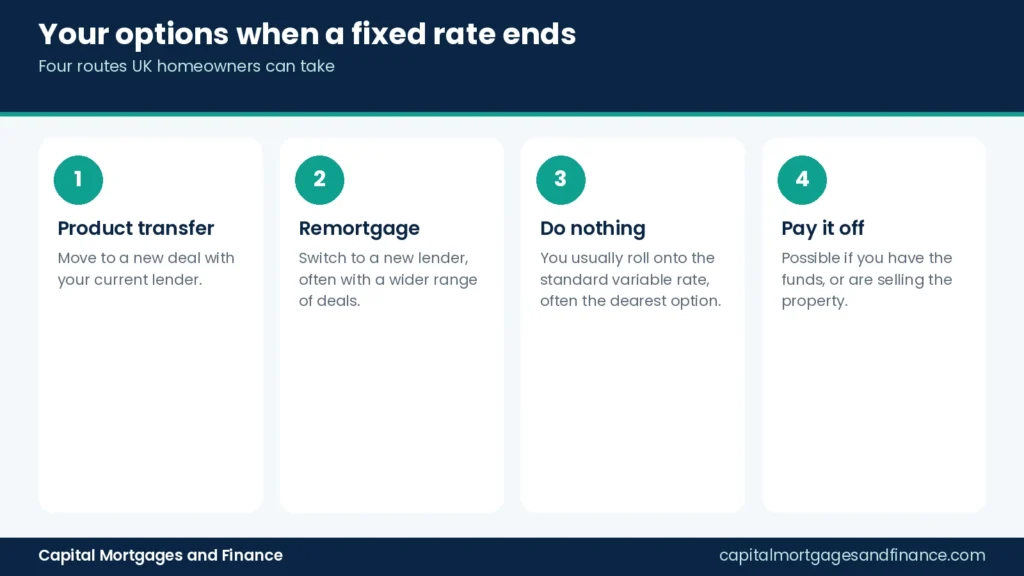
1. Product transfer with your current lender
You choose a new deal from your lender’s range and your mortgage continues as before. It is typically quick and often avoids legal and valuation costs. This is the most common route, and our product transfer guide explains it in depth.
2. Remortgage with a new lender
A remortgage lets you compare the whole market. It takes longer and involves a full application, but can be cheaper if you have built equity or if your lender’s rates are not competitive. We compare both routes in product transfer versus remortgage.
3. Do nothing
You move to the SVR. It is simple, but usually the most expensive option, and you can switch away at any time if you change your mind.
4. Repay the mortgage
If you have savings, an inheritance or are selling your home, you may repay in full. Check the date your fix ends and whether any early repayment charge applies before you do.
The numbers in October 2026
According to Uswitch on 26 October 2026, the average two-year fixed rate was 5.78% and the average five-year fixed rate was 5.81%, both at 75% loan to value (LTV) across all lenders. The average SVR was 7.24% across all lenders and 6.49% across the six biggest. The Bank of England’s Bank Rate stood at 3.75% after the Monetary Policy Committee held it in September, with its next announcement on 5 November 2026. You can follow the latest decision on the Bank of England Bank Rate page.
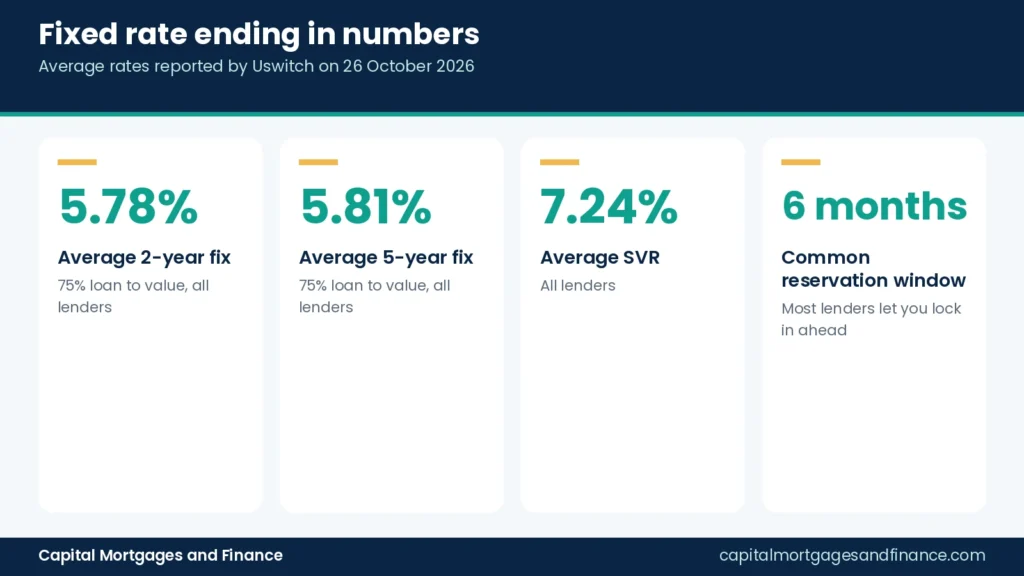
What does this mean for a typical household? Take a £150,000 balance with 15 years left. At 7.24% the repayment is about £1,368 a month. At 5.78% it is about £1,248 a month. That is a difference of roughly £120 a month, or £1,440 a year. For a £250,000 balance over 25 years, the two-year average of 5.78% costs about £1,577 a month, while the five-year average of 5.81% costs about £1,582, a difference of only about £5 a month. Illustrative figures like these show that the choice between two and five years is often about certainty and fees rather than a big difference in rate. Try your own numbers with our mortgage payment calculator.

Choosing your next deal
How long should you fix for?
There is no single right answer. A shorter fix, such as two years, gives you the chance to re-evaluate sooner if rates fall, but it also means you face another deal ending soon. A longer fix, such as five years, gives you certainty and fewer arrangement fees over time, but it may carry a larger early repayment charge if you want to leave early.
Think about your plans. If you might move, remortgage to release equity or pay off a lump sum within two years, a shorter deal or a flexible one may suit you better. If you want stability while your income or family costs are uncertain, a longer fix can help you budget.
Fixed or tracker?
A fixed rate stays the same. A tracker follows the Bank of England Bank Rate plus a set margin, so your payment can rise or fall. A tracker might suit you if you have savings to cover payment rises and want to benefit if rates drop; a fix suits you if certainty matters more. Our article on how a mortgage rate switch works explains the differences and our mortgage product switch guide covers how to compare them.
Do not forget the fees
A lower rate with a large product fee may not be better. If the fee is added to the loan, you pay interest on it. Compare total cost over the deal, not the rate alone. Using a calculator, an adviser or both can make this much easier.
Video: Fixed rate Mortgage ending? Here's what to do (Barclays UK, UK).
How early can you lock in a new rate?
Many lenders let you reserve a new product transfer rate up to about six months before your fix ends. Under the Mortgage Charter, lenders that signed up allow borrowers who are up to date with payments to secure a deal up to six months ahead and to switch to a better like-for-like deal with the same lender before their new rate starts, without a new affordability assessment. The details are on GOV.UK. If you remortgage, a broker can often secure an offer several months ahead as well, although terms differ by lender.
Securing early is a low-regret move. If rates rise, you have protected yourself. If they fall and your lender lets you switch, you can still benefit. Ask whether there is a fee to reserve and whether you can change your mind.
Managing payment shock
If your last fix began when rates were lower, your new payment may be noticeably higher. Here are practical ways to manage that:
- Test different terms. Extending the term spreads the cost but increases total interest. Use it as a temporary tool if you can.
- Check your LTV. A lower LTV can unlock a cheaper rate. Use our LTV calculator.
- Review your budget. Reducing other outgoings or increasing income can ease pressure.
- Talk to your lender early. If you are worried, ask about options under the Mortgage Charter, such as switching to interest-only for a period or extending your term, without damaging your credit file.
- Use free help. MoneyHelper explains what to do if you are worried about rising mortgages, and Citizens Advice supports people who are struggling with their debt and money.

Your fixed rate ending checklist
- Find the end date on your latest statement and set reminders for six, four and two months before.
- Get your lender’s product transfer options and note the fees and early repayment charges.
- Compare them with at least one remortgage quote or a broker’s search.
- Calculate the monthly payment and total cost for each deal.
- Reserve your chosen rate and confirm the start date in writing.
- Check your next statement to confirm the new rate and payment.
For consumer-friendly deal comparisons and guides, Which? has a useful overview of remortgaging, and MoneySavingExpert has a hub of mortgage guides. These sources can help you understand the market before you speak to your lender or adviser.
Mistakes to avoid when a fixed rate ends
- Leaving it too late. A remortgage can take four to eight weeks. Starting late can push you onto the SVR.
- Focusing only on the monthly payment. A longer term lowers it but increases the total cost.
- Ignoring overpayment limits. If you plan to overpay, check the allowance. Many deals allow around 10% of the balance each year without charge. See our overpayment calculator guide.
- Forgetting portability. If you may move, ask whether you can take the mortgage with you.
Three scenarios: what would you choose?
Numbers and rules matter, but real decisions are personal. These short examples show how different households might think about the same choice. They are illustrations, not recommendations.
Scenario 1: the cautious budgeter
Priya and Tom have two young children and a tight monthly budget. Their priority is knowing exactly what they will pay for the next five years, so they can plan childcare and bills. They compare a two-year fix with a five-year fix and find the monthly payments are almost identical. They choose the five-year fix and accept that moving house within five years could trigger an early repayment charge. For them, certainty is worth more than flexibility.
Scenario 2: the likely mover
Dan is single and expects a job relocation within 18 months. A long fix with a high early repayment charge would be risky. He asks his lender whether the mortgage is portable, and picks a two-year fix with a modest charge that falls each year. If he moves, he can take the deal with him or repay it with a small cost.
Scenario 3: the saver with a cushion
Margaret has a large emergency fund and a stable income. She is comfortable with some payment movement and wants to benefit if rates fall. She considers a tracker with no early repayment charge. If rates rise she can afford the extra cost, and if they fall her payments drop. She also keeps an eye on the market and reserves her rate early.
What if rates fall after you fix?
This is a common worry. If you fix for five years and rates drop after one, you could feel stuck. In practice, you have options: you may be able to switch earlier and pay an early repayment charge if the saving is larger than the charge, or you may be able to use any overpayment allowance to reduce your balance while you wait. Because the cost of leaving early can be large, it is sensible to ask in advance how the charge works and how it reduces each year. Our guide to early repayment charges on a product transfer explains this with examples.
On the other hand, if you reserve a rate six months ahead and rates fall before your current fix ends, many lenders allow you to switch to the cheaper deal without charge, so you do not have to guess. That is why early action usually works in your favour.
Will switching affect your credit?
A product transfer with your own lender typically involves little or no new credit checking, because you are not applying for new borrowing. A remortgage with a new lender usually involves a full credit search and affordability assessment. Either way, paying your mortgage on time and keeping other debts under control gives you the strongest position. If you have missed payments, speak to your lender and consider advice before applying to a new lender, as a failed application can leave a mark on your file. Our article on mortgage product transfer advice explains when speaking to an adviser first is sensible.
Other costs to remember
When comparing deals, remember that the headline rate is only one part of the picture. You may also need to consider:
- Product fees: paid upfront or added to the loan.
- Valuation and legal costs: often free on remortgages with incentives, and normally unnecessary on a product transfer.
- Exit fees: some lenders charge an administration fee when you close a mortgage or switch away.
- Broker fees: if you use a broker, ask how they are paid.
- Home insurance and life cover: your lender may require buildings insurance, and you may want to review your protection when you change your deal.
Frequently asked questions
What happens when my fixed rate mortgage ends?
You are usually moved onto your lender’s standard variable rate unless you choose a new deal. Your balance and term stay the same, but your rate and monthly payment can change.
Should I fix again or choose a tracker?
It depends on your budget and appetite for risk. A fixed rate gives payment certainty, while a tracker moves with the Bank of England Bank Rate and can fall or rise. Compare total cost and flexibility, and consider advice.
How far ahead can I secure a new rate?
Many lenders let you reserve a new rate about six months ahead. Lenders that follow the Mortgage Charter allow eligible borrowers to lock in a deal up to six months before their new rate starts.
Will I pay an early repayment charge when my fix ends?
Usually not if you switch when the fixed period ends, because the charge normally stops at the end date. If you leave early, a charge could apply. Check your mortgage offer.
What is the average five-year fixed rate in the UK?
Uswitch reported an average five-year fixed rate of 5.81% at 75% LTV on 26 October 2026. Your rate may be higher or lower depending on your LTV, lender and fees.
Is a two-year or five-year fix better?
Neither is better for everyone. Two years offers flexibility, while five years offers longer certainty and fewer arrangement fees. Choose based on your plans, budget and the early repayment charges.
Can I get help if the new payment is too high?
Yes. Contact your lender early. The Mortgage Charter gives eligible borrowers options such as switching to interest-only for a period or extending the term, and free help is available from MoneyHelper and Citizens Advice.
Final thoughts
A fixed rate mortgage ending is not a crisis if you plan ahead. Know your date, compare options about six months ahead and focus on total cost, not just the headline rate. If you would like a clear, jargon-free comparison of your lender’s offer and the wider market, speak to our team. You can also read our guide to mortgage renewal help for more support.
This article is for general information only and is not personal financial advice. Your home may be repossessed if you do not keep up repayments on your mortgage. Rates are averages reported by Uswitch on 26 October 2026 and will vary by lender, LTV and fees. Calculations are illustrative.
Need a website that brings in enquiries, or a CRM that follows them up automatically? Abbabeel Web builds fast, search-friendly WordPress websites and sets up GoHighLevel CRM systems, including sales pipelines, automated follow-ups, booking calendars and clear reporting for service businesses. Whether you run a mortgage practice or any other company, you can see our work at abbabeelweb.com or hire the team through our Fiverr profile. Get in touch today and let us build the website and CRM workflow that helps your business grow.