

A mortgage product switch is the change from your current mortgage product to a new one, usually with the same lender. It is how most UK homeowners avoid the standard variable rate when a deal ends, and it is also how you can change the type of deal you are on, from a fixed rate to a tracker, for example, or from a two-year deal to a five-year one. This guide explains how a product switch works, the main types of product, how to compare them and what to check before you commit.
What is a mortgage product switch?
A mortgage product is the package of terms that sits on top of your loan: the interest rate, how long it lasts, the fees, the early repayment charge and any special features such as overpayment allowances. A product switch replaces that package with another while the underlying loan, the property and the lender stay the same.
You may also hear it called a product transfer, a rate switch or an internal switch. These terms are often used interchangeably, though some people reserve “product switch” for a change of product and “product transfer” for the whole process. The key idea is the same. Our mortgage product transfer guide walks through the process in detail.
Types of product you can switch to
Fixed rate
The interest rate stays the same for an agreed period, commonly two, three, five or even ten years. Your payment does not change during that period, which makes budgeting simple. When the fix ends, you move to the standard variable rate unless you switch again.
Tracker rate
The rate moves in line with a benchmark, usually the Bank of England Bank Rate, plus a set margin. If the Bank Rate goes up, your rate goes up by the same amount. If it goes down, your rate goes down. Some trackers last two years, others for the life of the mortgage.
Discount variable rate
A discount off the lender’s standard variable rate for a set period. Because the SVR can change at the lender’s discretion, your rate can move even if the Bank Rate does not. These deals are less common than fixed and tracker rates.
Standard variable rate
The lender’s default rate. It is not usually something you choose, and it is normally the most expensive option, but it does allow you to leave without paying an early repayment charge.
Fixed or tracker: which suits you?
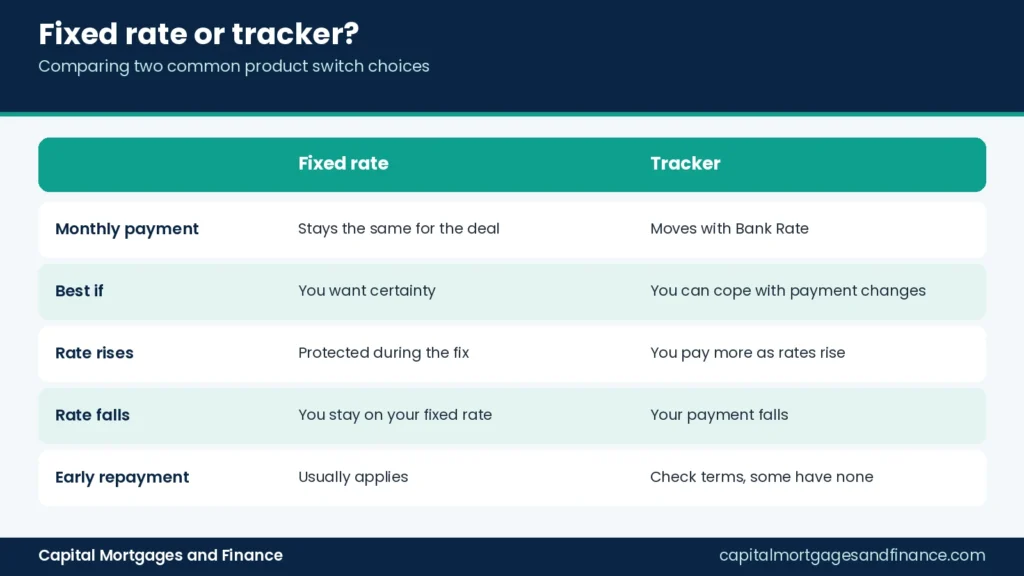
Neither is better in every case. A fixed rate gives you certainty, which is valuable if your budget is tight or you cannot absorb payment rises. A tracker can be cheaper at the start in some markets, can fall if the Bank Rate falls, and sometimes comes with lower or no early repayment charges, but it carries the risk of rising payments.
Ask yourself:
- Could I afford my payment if it rose by a few hundred pounds a month?
- Do I value certainty more than the chance of saving money?
- Do I plan to move, remortgage or repay in the next two years?
- Do I have savings to cover a rise in payments?
Our guide to how a mortgage rate switch works goes deeper into the fixed versus tracker choice.
A tracker example with real numbers
The Bank of England’s Bank Rate is 3.75% at the time of writing, as shown on the Bank of England Bank Rate page. Imagine a tracker priced at Bank Rate plus 1.50%, which is 5.25%. On a £200,000 balance over 20 years, the repayment would be about £1,348 a month.
| Bank Rate change | Tracker rate | Monthly payment | Change |
|---|---|---|---|
| Falls by 0.25 points | 5.00% | about £1,320 | about £28 lower |
| No change | 5.25% | about £1,348 | none |
| Rises by 0.25 points | 5.50% | about £1,376 | about £28 higher |
| Rises by 0.75 points | 6.00% | about £1,433 | about £85 higher |
For comparison, a fixed rate at the October 2026 two-year average of 5.78% (Uswitch, 26 October 2026, 75% loan to value) would cost about £1,408 a month and would not change during the fix. So, in this example, the tracker would be cheaper unless the Bank Rate rises by more than about 0.5 percentage points. These are illustrative calculations, not forecasts, and real products vary. They show how a tracker’s cost depends on future rate moves, while a fixed rate removes that uncertainty. You can run your own numbers using our mortgage payment calculator.

Mortgage product switch checklist
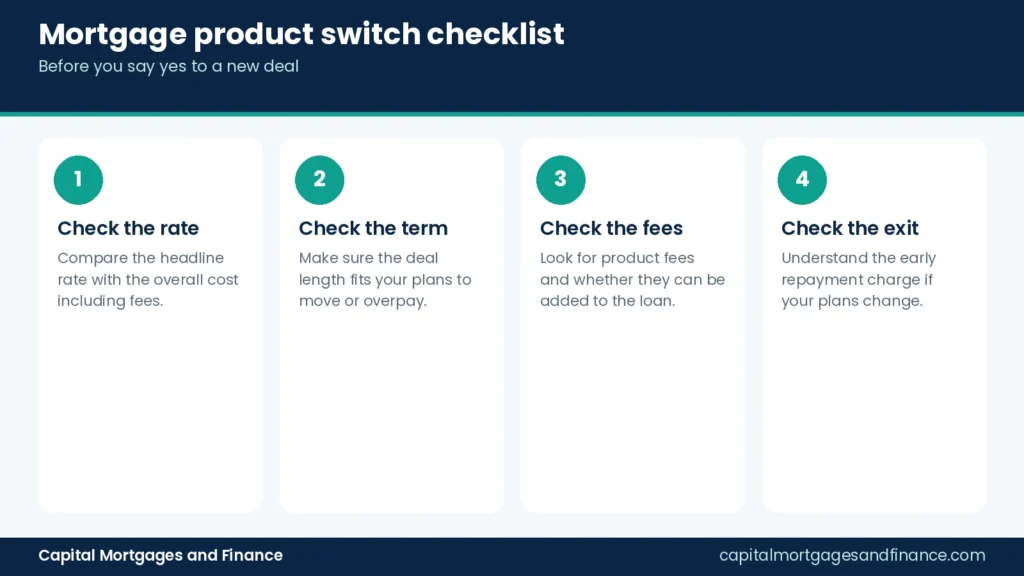
1. Check the rate
Compare the headline rate, but also ask how the rate is calculated. For a tracker, what is the margin and what happens if the Bank Rate falls to a very low level? Some trackers have a floor that stops the rate falling below a set level.
2. Check the term
Make sure the length of the deal fits your plans. A deal that ends in two years gives flexibility but means another switch soon. A five-year deal gives longer certainty but may have a bigger early repayment charge.
3. Check the fees
Look at the product fee, any exit or administration fee, and whether fees can be added to the loan. If a fee is added, you pay interest on it. A £999 fee added to a mortgage at 5.78% over 20 years adds roughly £7 a month, or about £1,690 in total over the term, so paying it upfront can be cheaper if you can afford to.
4. Check the exit
Understand the early repayment charge and when it stops. Our guide to early repayment charges on a product transfer explains how they are typically structured.
Video: Fixed Rate Mortgages UK – (COMPLETE Beginners Guide) (Alex Kerr, Mortgage Chain Ltd, UK).
Switching part-way through a deal
You can switch product before your deal ends, but you may need to pay an early repayment charge. Whether it is worth doing depends on the size of the charge and the saving. As a quick test, work out the monthly saving from the new rate, multiply by the months left on the old deal and subtract the charge and any new fees. If the result is positive, a mid-deal switch could make sense.
Some lenders let you reserve a new rate months before your deal ends, so you can lock it in without paying a charge. This is usually the best way to secure a lower rate without paying a penalty. Ask your lender whether it allows this and what the reservation window is.
How a product switch works in practice
- Check your end date and your lender’s reversion rate.
- Ask for the list of products open to you, including fixed and tracker deals.
- Compare the monthly payments and total costs, perhaps using our product transfer calculator.
- Check the market with a broker or comparison tool to see whether a remortgage could beat the offer.
- Choose a product and confirm the start date and terms in writing.
- Check the next statement to confirm the new rate.
If you want a personal recommendation, read about mortgage product transfer advice.

Mistakes to avoid
- Choosing a tracker you cannot afford if rates rise. Test your budget at a higher rate first.
- Choosing a long fix that does not match your plans. If you may sell soon, the charge could outweigh the benefit.
- Ignoring fees. The cheapest rate may not be the cheapest deal.
- Waiting until the deal has ended. You will usually be moved to the SVR automatically.
- Not comparing with the market. A remortgage may be cheaper, as covered in product transfer versus remortgage.
How long should your new deal last?
The length of your new product is just as important as the rate. Here is how the main options compare in everyday terms:
- Two years. Offers flexibility and a quicker chance to benefit if rates fall. It means more frequent switching and potentially more fees over time.
- Three years. A middle ground that is less common but can work well if you expect a change in circumstances in a few years.
- Five years. Gives longer certainty and fewer arrangement fees, but a larger early repayment charge if you leave early.
- Ten years. Rarer and aimed at people who want certainty for a decade, with the trade-off of a long commitment.
- Lifetime tracker. Follows the benchmark rate plus a margin for the whole mortgage term, often without early repayment charges, but with no payment certainty.
On a £250,000 balance over 25 years, Uswitch’s average rates on 26 October 2026 gave a monthly payment of about £1,577 on a 5.78% two-year fix and about £1,582 on a 5.81% five-year fix. The payments are almost identical, so the decision turns on how certain you want to be and how likely you are to move or remortgage within five years.
Features that can make a product more useful
Some products offer features beyond the rate. Whether they are valuable depends on how you manage your money.
- Overpayment flexibility. Allows you to pay extra without a charge, usually up to a yearly limit.
- Underpayments or payment holidays. Lets you pay less, or nothing, for a limited time if you have previously overpaid.
- Offset arrangements. Link your savings to your mortgage so you pay interest only on the difference. These are less common and often carry higher rates, but may suit people with substantial savings.
- Portability. Lets you take the product to a new property if you move, subject to the lender’s criteria.
- Cashback or free services. More common on remortgages than on product switches, but worth asking about.
If you plan to overpay regularly, see how it affects your balance using our overpayment calculator guide, and make sure the new product’s allowance matches your plan.
Worked example: choosing between three products
Imagine you have a £200,000 balance with 20 years left, and your lender shows these three products:
- A two-year fix at 5.70% with a £999 fee.
- A five-year fix at 5.85% with no fee.
- A two-year tracker at Bank Rate plus 1.50%, currently 5.25%, with no fee and no early repayment charge.
On a repayment basis, the monthly payment would be about £1,400 on the first product, about £1,415 on the second and about £1,348 on the third at today’s Bank Rate. Over two years the first costs about £33,560 plus the £999 fee, the second about £33,970 and the third about £32,340, so the tracker is roughly £1,630 cheaper than the five-year fix over that period. It stays the cheapest unless the Bank Rate rises by around half a percentage point or more soon after you start. That sounds like an easy win for the tracker, but only if you can afford the payment rising. If a rise of three-quarters of a point would stretch your budget, the five-year fix may be a better fit even though it costs more today. The point is to compare the products using your own numbers and your own risk limits, not simply to follow the lowest figure. These figures are illustrative only.
Frequently asked questions
What is a mortgage product switch?
A mortgage product switch is a change from your current mortgage product to a new one, usually with the same lender. Your loan and property stay the same, but the interest rate, deal length and fees change.
Is a product switch the same as a product transfer?
In everyday use, yes. Both terms describe moving to a new mortgage deal with your existing lender. Some people use product switch for the change itself and product transfer for the whole process.
Can I switch from a fixed rate to a tracker?
Usually yes, if your lender offers tracker products and you meet its criteria. Make sure you can afford your payment if the Bank of England Bank Rate rises.
Will I pay a fee to switch my mortgage product?
Many products carry a product fee, which can sometimes be added to the loan. If you switch before your current deal ends, an early repayment charge could also apply. Compare the total cost of each option.
Can I switch my mortgage product at any time?
You can, but switching before your deal ends may trigger an early repayment charge. Switching when the deal ends, or reserving a new rate ahead of time, usually avoids a charge.
Does a product switch need a credit check?
A like-for-like switch often needs little or no new credit checking, because you are not applying for new borrowing. Policies vary, so ask your lender.
Is a tracker mortgage a good idea at the moment?
It depends on your budget and risk tolerance. A tracker can be cheaper if the Bank Rate falls, but your payments will rise if it increases. Test your budget at a higher rate and consider advice.
Final thoughts
A mortgage product switch is a quick, flexible way to take control of your mortgage costs. Think about what you value most, whether that is certainty, flexibility or the lowest possible rate, and choose a product that fits your plans. If you would like help comparing your lender’s products with the market, speak to our team. You can also read our guide to switching your mortgage deal with the same lender.
This article is for general information only and is not personal financial advice. Your home may be repossessed if you do not keep up repayments on your mortgage. Figures are illustrative and based on October 2026 sources. A tracker rate can go up as well as down.
Need a website that brings in enquiries, or a CRM that follows them up automatically? Abbabeel Web builds fast, search-friendly WordPress websites and sets up GoHighLevel CRM systems, including sales pipelines, automated follow-ups, booking calendars and clear reporting for service businesses. Whether you run a mortgage practice or any other company, you can see our work at abbabeelweb.com or hire the team through our Fiverr profile. Get in touch today and let us build the website and CRM workflow that helps your business grow.